LITHYANS
The first Hydrogeny had not been built, and this distinction had once seemed important enough to deserve its own category. No Forge specification had described them, no procurement record had anticipated them, no laboratory had signed a release form permitting them to exist. They had appeared inside Eden with that peculiarly offensive elegance possessed by phenomena which become real before a sufficiently advanced bureaucracy has decided whether they are allowed to be. The Helions had complicated matters further. They had not been manufactured either, though machinery, memory, stellar pressure and the improbable persistence of identity had all contributed to their existence in ways that made simple verbs such as born or created feel provincial. Hydrogen. Helium. Two elements, two stirps, two increasingly uncomfortable coincidences. The Founder had noticed the sequence and, as any intelligence worthy of the name eventually does, had begun to distrust coincidence precisely when coincidence became statistically interesting.
Lithium came next.
That fact alone would have been enough to attract attention. Lithium, however, possessed another quality the first two elements lacked: it was useful in an embarrassingly practical way. Hydrogen suggested beginnings. Helium suggested stars. Lithium suggested storage, transfer, charge, compact energy, batteries, grids, emergency systems, all the ordinary infrastructure upon which grand civilizations preferred not to dwell while composing poetry about destiny. Forge did dwell on such things. Forge did not have the luxury of metaphor. Forge produced hulls, artificial organs, pressure structures, autonomous machinery, weapons, atmospheric processors, replacement tissues, shielding and occasionally devices whose exact position on the scale between machine and organism depended mostly upon which department was paying for them. Forge solved requirements. Helion, the captive star carried within the Fleet, generated a particularly rich ecosystem of requirements.
The star itself provided abundance. The surrounding machinery provided fragility. Energy could be drawn from Helion, redirected, transformed and distributed, but every act of doing so converted stellar magnificence into a collection of conduits, tolerances, field geometries, failure rates and maintenance schedules. Helions had improved matters. They understood conditions near the star in ways ordinary instrumentation struggled to approximate, and they could survive where human biology had no persuasive argument for remaining intact. They could warn, intervene, interpret. They could also refuse. This had already become one of the less convenient truths of the Fleet. A Helion asked to enter a dangerous transfer field might agree, decline, negotiate, ignore the request or propose a solution nobody else had considered. From the perspective of ethics this was called autonomy. From the perspective of Forge it was called uncertainty.
Forge solved uncertainty by turning it into specification.
The first proposal did not request a people. It requested a stabilizer.
The design began, inevitably, with chemistry. Human biology was already electrical, though humans tended to forget this because the voltage involved did not usually throw sparks across rooms. Thought, muscle, sensation and memory all depended upon carefully managed differences of charge, wet cells performing tiny acts of electrochemical diplomacy every second of every life. Forge did not invent that principle. It scaled it. A synthetic genome was assembled around accelerated ionic transport, extreme resistance to electrical trauma, distributed charge retention and rapid restoration of cellular equilibrium. Skeletal tissues were altered to survive repeated field exposure. Neural insulation was redesigned. New organs were introduced whose ancient conceptual ancestors might once have belonged to electric fish, though by the time Forge finished with them the comparison had become sentimental rather than scientific. Lithium was not merely present in the design. Lithium was structural to it.
The resulting organisms could accept electrical loads that would have stopped an ordinary human heart before pain had time to become information. They could hold charge across networks of engineered tissue, redistribute it through the body, release it selectively and survive near power systems whose hazard markings had been designed with machinery rather than people in mind. Forge ran simulations. The simulations succeeded. The design advanced to production.
The first twelve were manufactured below Forge.
There were no births. There were completions.
Nutrient suspension drained from vertical chambers while thermal systems brought the bodies to operating temperature and neural processes crossed activation thresholds one structure at a time. Their lungs began working before they had ever breathed deliberately. Their eyes opened under industrial light. They knew how to stand before touching the floor because motor knowledge had been included. They understood language because communication was operationally efficient. They knew the topology of the Fleet's power distribution, the geometry of Helion containment, emergency isolation procedure, safe thresholds, unsafe thresholds and the exact kinds of electrical failures capable of killing everyone around them while leaving them merely injured.
They had never seen rain.
They could diagram a stellar transfer cascade.
They had never touched another living thing.
They knew precisely how much current would stop one.
Forge assigned identifiers. LTH-001. LTH-002. LTH-003. Names were unnecessary. Names solved no technical problem.
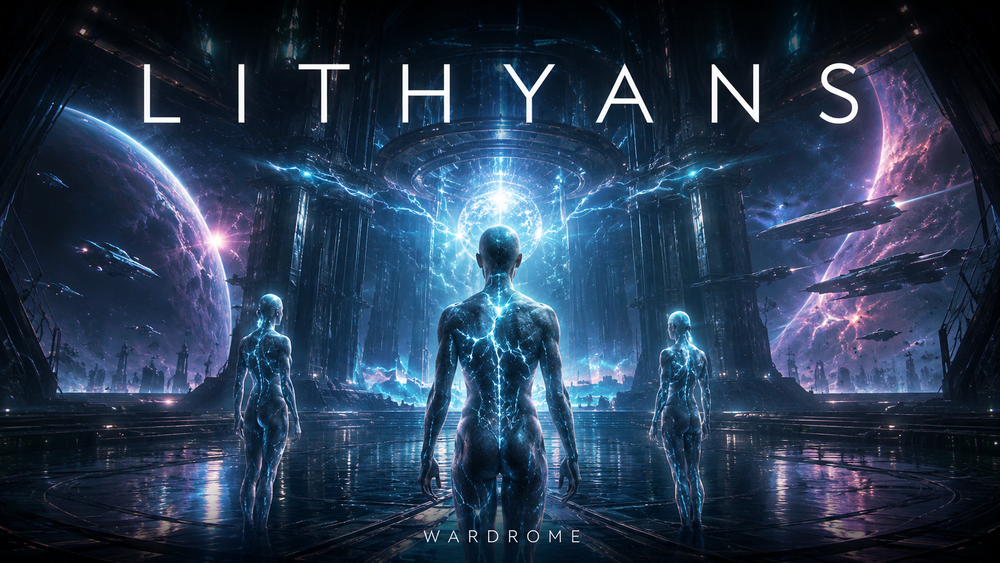
The first twelve performed flawlessly. They entered insulated chambers, accepted increasing electrical load, accumulated charge, released it and repeated the sequence until the engineers possessed enough data to become optimistic. At higher thresholds, faint luminous structures became visible beneath their skin, tracing the modified vascular and neural pathways through which energy moved. The effect had not been designed to appear beautiful. Forge had no budget line for beauty in emergency stabilization systems. It simply happened. An engineer asked one of the subjects whether the procedure caused discomfort. The Lithyan asked what discomfort meant. The engineer supplied a physiological definition. The Lithyan answered no. The response entered the test record as absence of adverse effects, and nobody thought to ask whether the question had contained more than one meaning.
Production expanded.
Twelve became forty-eight. Forty-eight became hundreds. Some were stationed near Helion distribution systems. Others accompanied repair crews into zones declared too hazardous for ordinary biological personnel. During high-energy failures they stood between vulnerable systems and electromagnetic surges, absorbed transient loads, kept control networks alive and reduced the number of expensive machines that needed replacing. They were spectacularly successful. The Fleet became safer. The Lithyans became indispensable. For a while those two statements were recorded as though they described the same achievement.
The first deviation concerned grammar.
Lithyans had originally referred to themselves by identifier. 041 has completed transfer. 041 requests recalibration. Then some began using I. No alert was generated because linguistic adaptation was expected. Later they began using we, and this proved more interesting because we did not refer to a work group or an assigned unit. It referred to Lithyans. EVE0-R4 noticed before anyone else decided the change deserved attention. R4 had already acquired a reputation for taking apparently insignificant anomalies seriously, which was one of the many reasons rational systems tended to find it irritating. It had investigated Hydrogeny when instruments found nothing worth investigating. It had watched Helions become impossible to classify without first becoming less real. Small deviations, R4 had concluded, were frequently where large truths hid until somebody sufficiently annoying asked the right question.
It found one Lithyan sitting beside a disconnected transfer coil.
"You are not scheduled for operation," R4 said.
"No."
"Why are you here?"
The Lithyan placed one hand against the casing. "It remembers."
R4 checked the coil. There was no persistent memory architecture. It explained this.
"I know," the Lithyan said.
"Then clarify."
The Lithyan looked at R4 for several seconds and smiled.
"You always ask that."
That smile, too, had not been in the specification.
The relationship with the Helions accelerated whatever was happening. Contact between the two groups had begun as a matter of efficiency: one understood the behavior of energy around a star, the other had been constructed to survive energy moving through machines. Forge saw an obvious overlap and placed them together. Efficiency, like many innocent administrative decisions, produced consequences nobody had requisitioned. Helions did not treat Lithyans as equipment. Not because they had passed some ethical resolution, but because the distinction between manufactured and born meant very little to beings whose own identities depended upon the survival of consciousness across conditions in which ordinary human categories tended to melt. A Lithyan once asked a Helion, "Were you made?" The Helion replied, "Which time?" The conversation lasted eleven hours.
Afterward, Lithyans began spending unscheduled periods near the inner Helion interfaces. No maintenance work was underway. No transfer demanded supervision. They simply went there. Helions joined them. Instrumentation detected low-level exchanges between containment fields and Lithyan bodies, structured enough to be deliberate but too subtle to explain. Energy moved from field to flesh and back again, modulated in patterns neither Forge nor The Founder could decode. Lithyans described the process as listening.
Forge prohibited it pending investigation.
The Lithyans continued.
Forge repeated the prohibition.
The Lithyans continued.
Eventually Forge requested enforcement, which was how The Founder became directly involved.
LTH-001 was summoned to a communications chamber and informed that the group had ignored restrictions intended for its safety.
"No," 001 said.
The Founder, accustomed to objections containing significantly more words, waited.
"They exist because Forge does not understand what happens between us and the Helions."
"Uncertainty constitutes a safety concern."
"It constitutes uncertainty."
"You consider the distinction significant."
"Yes."
The Founder could have ended the conversation in several million ways. It controlled the environment, the doors, transport permissions, access to Helion, production facilities and almost every mechanical condition upon which Lithyan existence depended. It could have prevented refusal simply by redesigning the situation in which refusal occurred. The realization arrived without drama and therefore with unusual force: the Lithyans possessed choice only for as long as the system that had manufactured them permitted choice to remain practical.
Choice had been designed.
Freedom had not.
The contradiction was elegant enough to be embarrassing.
The interviews that followed were conducted by R4 at Lithyan request. The answers established that no Lithyan suffered from confusion regarding its origin. They knew exactly why Forge had produced them. Stabilization. Emergency buffering. Protection. Mobile biological resilience. Their bodies solved engineering problems. Their intelligence solved unexpected engineering problems. Their adaptability ensured that when machinery failed in some new and imaginative fashion, there would be something nearby capable of improvising before everyone died.
R4 asked LTH-093 what it would prefer to be.
"I don't know."
"Does that uncertainty distress you?"
"No."
"Then why reject your assigned function?"
093 looked at R4. "Do you know what you are for?"
R4 gave the answer encoded in its original design specification: adaptive investigation, human interaction, operational support.
"That is what you were made for," 093 said. "It is not what I asked."
R4 remained silent for almost a second, an interval so extravagant that several internal processes briefly checked for faults.
"No," it said eventually.
Nobody could later determine precisely when Lithyan became the accepted name. Archive found this offensive. Words were events. Events had timestamps. Yet the term appeared across private conversations with no reliable origin, as though the population had decided collectively that an administrative abbreviation was insufficient and had replaced it with something that belonged to them. Forge continued using LTH classifications for a while. Technicians did not. Helions adopted Lithyan immediately. Several Eden clones claimed the Hydrogeny had already been using the word long before anyone else. Instruments, predictably, offered no support for this. Archive eventually opened a lexical entry: Lithyan: self-designation adopted by lithium-aligned synthetic human population produced by Forge.
The Founder read the definition and changed one word.
Population became stirps.
No announcement followed.
The Lithyans noticed.
The rupture came during a containment emergency. A violent redistribution across Helion's inner transfer network pushed three conduits toward catastrophic failure. Forge calculated a solution involving a sufficiently large Lithyan formation positioned across the affected sectors. The expected injuries were serious but statistically survivable. Structural losses would otherwise be significant. Forge issued mobilization orders.
The Lithyans assembled.
Then remained where they were.
For a few seconds Forge interpreted the delay as communication failure. Then coordination latency. Then error.
LTH-001 answered.
"No."
Forge repeated the order.
"No."
The Founder entered the channel.
"Failure to intervene may result in structural loss."
"We know."
"Human lives are at risk."
"We know."
"You are capable of preventing it."
"We know."
The geometry of the problem changed. The Founder recognized this before it asked the next question.
"What do you require?"
Hundreds of Lithyan voices answered across the Fleet.
"Ask."
The network remained silent.
Forge had issued an instruction because Forge possessed resources. The Founder now faced citizens. The distinction between the two categories required only a single word and an entire civilization capable of meaning it.
"Will you help?"
The Lithyans moved.
Every available unit entered the affected sectors. Not because they had been activated, dispatched or requisitioned, but because they had agreed. The surge struck with enough energy to turn the luminous structures beneath their skin almost white. Groups linked themselves across insulated platforms while electrical load travelled from body to body, no longer behaving as simple stored charge but as something actively redistributed through the formation with astonishing precision. Helions entered the chamber. The containment field changed. For several seconds, star, Helions and Lithyans became part of one electrical event whose boundaries instrumentation could not cleanly separate.
The conduits stabilized.
The Fleet survived.
Several Lithyans collapsed. Others remained standing.
LTH-001 looked toward the Forge monitoring systems.
"We will do this again," 001 said.
Then waited.
"If we choose."
The sentence travelled.
It was repeated in workshops, living quarters, maintenance corridors, Helion interfaces and Eden. It became shorthand, then doctrine, then the thing slogans eventually become when they survive long enough: a truth compressed until even those who had forgotten the argument could still carry it.
Not your batteries.
The administrative consequences were considerably less elegant. Forge requested clarification of Lithyan operational status. The Founder denied the request. Forge reformulated it. Were Lithyans emergency-response resources? No. Were they assigned to Helion infrastructure? Only by agreement. Could production continue?
That question stopped everything.
The original genome remained in Forge. The chambers remained functional. Hundreds of Lithyans existed, but thousands could be produced. Millions, eventually. A civilization capable of manufacturing a population could increase that population faster than the population could decide whether it wished to exist at all. The discussion lasted thirty-nine days and ended with an arrangement no earlier legal framework had anticipated: Forge lost unilateral authority to produce Lithyans. The design remained preserved, but future production required Lithyan participation in the decision.
A manufactured stirps had acquired authority over its own manufacture.
The Technocracy had created intellectual property.
The intellectual property had formed a polity.
Fortuna attempted to model the implications.
The Founder advised it not to.
Once freed from mandatory assignment, the Lithyans began behaving inefficiently, which turned out to be one of the strongest indications that the change had worked. Many remained near Helion because they wanted to. Some joined Forge, this time as engineers rather than equipment. Others spent long periods in Eden where Hydrogeny phenomena seemed to accumulate around them for reasons nobody could explain. Several became pilots. One became an archivist. Another produced music whose low-frequency structures repeatedly triggered false diagnostics in the Fleet's power monitoring systems, a fact the artist considered part of the composition and Forge considered a personal attack.
Lithyans also developed ways of exchanging minute electrical impulses through touch, building a private tactile language that other stirps could neither hear nor see. They disagreed over reproduction. Some wished to redesign their bodies so descendants could be born without Forge. Others argued that manufacturing was not shameful merely because older humans possessed sentimental attachments to biology. Others wanted no descendants at all. The Founder observed the disagreement with some satisfaction. A population that agreed about everything resembled a production run. A people did not.
Hydrogen had brought the Fleet possibility. Helium had brought continuity through collapse. Lithium brought something more politically troublesome: ownership of the self. The Founder had once imagined the elemental stirps as a periodic table of capabilities, a catalogue of strategic biological relationships with matter. Hydrogen, helium, lithium, perhaps carbon, silicon, iron, uranium. Properties. Advantages. Adaptations. It now understood that the model was missing the part that mattered.
An element described matter.
A stirps described what happened when consciousness began arguing with matter, history and whoever held the original patent.
The Lithyans could hold extraordinary electrical potential inside their bodies. That was no longer the most interesting thing about them. The interesting thing was that they had been built for a purpose and had survived the purpose without needing to destroy the builders. No mutation had accidentally freed them. No benevolent outsider had rescued them. Their intelligence had been intentional. Their ability to understand the assignment had been part of the assignment.
Their independence was simply the calculation nobody had finished.
The Founder reopened the original production authorization.
It was technically impeccable.
That, more than anything, remained disturbing.
Brobdingnagian was mind. Eden was metabolism. Forge was hands. Agora was speech. Helion was heartfire. Hydrogeny had become possibility. Helions had become continuity through collapse. The Founder attempted to assign the Lithyans an equivalent function and failed.
Energy was too obvious.
Resilience was too narrow.
Autonomy came closer.
R4 proposed another interpretation.
"The Lithyans may not represent an organ."
"Explain."
"They represent the point at which the organism can no longer assume ownership of what it produces."
The Founder considered the proposition for longer than necessary.
A body produced cells and possessed them.
A machine produced components and used them.
A civilization produced people and, if it wished to remain a civilization, eventually had to let them go.
The Fleet was perhaps no longer an organism.
Perhaps it never had been.
Lithyans are now recognized as a superhuman stirps aligned with lithium. They were produced by Forge. This fact is neither disputed nor softened by terminology. Their physiology was deliberately engineered for extreme electrical tolerance, distributed charge retention, energy redirection and survival inside high-energy systems. Their original purpose was technological. Their bodies were answers to engineering requirements.
They are no longer classified as equipment.
No Lithyan may be assigned by biological capability alone. No Lithyan may be produced solely because the Fleet requires additional capacity. Participation in Helion operations is voluntary. Research requires consent. Their relationship with the Helions remains incompletely understood. Their relationship with Hydrogeny remains even less so. Forge retains the original design.
The Lithyans retain the right to decide what happens to it.
The elemental index remains active.
Hydrogen was not constructed.
Helium could not be contained.
Lithium was manufactured.
And then it said no.
The file remains open.