The Anti-Mythology of Indie: why making an indie game today is not “resisting” but engineering complex systems with asymmetric resources
The contemporary indie story often gets told as an ethical romance: the lone creator “resists” the mainstream, refuses the studio machine, and makes something pure. That story still exists—sometimes it’s even true at the level of personal motivation—but it is a misleading frame for understanding what actually happens in production. In practice, “indie” describes a mode of engineering under asymmetric constraints: unequal funding, unequal marketing reach, unequal labor specialization, unequal access to platform leverage, and unequal tolerance for failure. (https://scispace.com/pdf/narratives-of-independent-production-in-video-game-culture-2ltwgau4o8.pdf)
Indie work is therefore less a rebellion against a system than a way of operating inside one—platform policies, storefront economics, tool ecosystems, and labor realities—while building coherent, testable, shippable systems anyway. Scholars who study indie discourse have explicitly argued that “opposition” is not the right mental model: the relationship is relational, historically shifting, and often grounded in “indie markers” and narratives rather than any stable essence. (https://septentrio.uit.no/index.php/eludamos/article/download/vol2no1-2/5821?inline=1)
“Indie ≠ small” is also not a slogan; it’s a technical statement. Many indie successes are small in asset count, but not small in design density—they concentrate value in rules, simulation, combinatorics, systemic narrative, or tool-supported iteration. This is why some of the most “indie” work looks like a compact interface wrapped around an absurdly deep machine. (https://stackoverflow.blog/2021/12/31/700000-lines-of-code-20-years-and-one-developer-how-dwarf-fortress-is-built/)
AI intensifies this reality rather than dissolving it. It can accelerate drafts and prototypes, but it also increases integration overhead, quality uncertainty, legal/ethical exposure, and workflow coordination. The result is not a “solo dev made easy,” but something closer to a cognitively overloaded mid-size studio collapsed into one person: multiple “departments” worth of output with none of the managerial buffers that normally stabilize them. (https://investgame.net/wp-content/uploads/2025/03/0794a269-d5c4-4994-9bcf-8c5730d0815e_2025_GDC_State_of_the_Game_Industry_report-1.pdf)
Finally, the core strategic act of indie engineering is not adding features. It is deciding what not to simulate—what to abstract, what to proceduralize, what to fake, what to cut, and what to keep sacred because it carries the fantasy. The highest-leverage choice is rarely “work harder”; it is “define the system boundary.” (https://www.factorio.com/blog/post/fff-284)
Indie as engineering, not romantic resistance
Narrative angle: indie as engineering, not romantic gesture.
An “indie game” is a product that must run reliably on real hardware, survive player behavior, and ship through platform processes. That pushes the work toward engineering disciplines—systems design, performance, tooling, QA strategy, configuration control, distribution compliance—even when the aesthetic reads as handmade. Indie discourse frequently treats “independence” as authenticity, but the operational reality is closer to systems work under constraint: architecting, instrumenting, and iterating until the artifact holds. (https://jesperjuul.net/text/independentstyle/)
This is why a lot of “indie identity” is expressed through choices that function like engineering decisions dressed as style: reduced palettes, constrained scopes, deliberate retro affordances, and “small” interfaces that mask complex logic. Jesper Juul argues that an “independent style” helps low-resource games be recognized as deliberate decisions rather than “cheap versions” of big-budget work—a cultural mechanism that translates resource scarcity into legibility and value.
Foundational misconception: indie as rebellion vs indie as system.
A persistent myth says “indie” is defined by resisting the mainstream. But indie scholarship (and many industry observations) tends to treat the category as relational: independent from something (publishers, investors, intended audience expectations, distribution constraints), yet still embedded in infrastructures owned by major actors. (https://gamestudies.org/1601/articles/gardagrabarczyk)
That relational view matters because the same project can be “indie” in one dimension and “dependent” in another. One influential attempt to clarify this distinguishes financial, creative, and publishing independence—and then notes that “indie” often becomes a set of contingent, time-bound “markers” (retro style, small team, certain distribution paths) that are easier to recognize than the underlying economic relationships.
A complementary line of argument is even more direct: independent games may be innovative, but they are not necessarily an oppositional “radical other” to mainstream production. Andreas Jahn-Sudmann frames this as “innovation not opposition,” emphasizing that “independence” always prompts the question “independent from what,” and observing that many independent games still align with popular logic rather than explicitly negating mainstream forms.
So what is “anti-mythology”?
It is the refusal to treat indie as a moral stance that substitutes for production analysis. The anti-mythology lens says: even when the personal story is rebellion, the technical story is accommodation and optimization—designing within constraints imposed by platforms, by labor capacity, by discoverability economics, and increasingly by AI-era content governance.
Density not size
Density not size: indie ≠ small.
If “size” means asset volume—unique environments, voiced dialogue hours, cinematic cutscenes—indie is often small because asset production is expensive. But if “size” means state space (how many interesting situations the system can produce), indie can be enormous. This is the “density” thesis: value concentrates in rules, simulation, combinatorics, and tool-driven iteration rather than in raw content throughput.
One way to see density is to watch where advanced indie teams spend their time: not only in adding content, but in making the machine stable—performance profiling, determinism, data structures, edge cases, and long-tail bug behavior. (https://www.factorio.com/blog/post/fff-421)
Concrete example: systemic density via interface compression.
Papers, Please is often remembered for its emotional and political framing, but its production story (as recorded in Lucas Pope’s devlogs) reads like system design: the core loop is document comparison, discrepancy detection, fraud detection, and consequence modeling. Pope describes deliberately building mechanics that allow many error types to be expressed through a simple “inspect mode” interface (highlight two facts; if they conflict, unlock actions). That is design-as-compiler: define a grammar of discrepancies so content scales through rule composition rather than bespoke scripting. (https://dukope.com/devlogs/papers-please/tig-01/)
Even the “art style” discussion is framed operationally: pixel art is chosen because it is faster and more enjoyable for the creator, and because constraints like limited palettes and modular face parts support variation systems (including “slightly wrong” forged documents). That is density engineering: deepen the combinatorial space of faces and documents without paying linear costs in illustration. (https://dukope.com/devlogs/papers-please/tig-00/)
Concrete example: performance as design boundary.
Factorio is a canonical case that “indie” can mean deep systems plus relentless optimization. Its official “Friday Facts” posts are notably technical: modeling overlapping radar coverage with counters, restructuring “read” operations for multithreading, rejecting multithreading ideas when memory throughput becomes the bottleneck, and emphasizing determinism to avoid simulation desync. This is not “small”; it is complex infrastructure work aimed at preserving the fantasy of “bigger and bigger systems” that still run.
Concrete example: longevity through simulation growth.
Dwarf Fortress is frequently used as shorthand for “complex simulation,” but the key point here is production shape: a long-running, single-developer (with design collaboration) codebase that accretes systems over decades, with constant trade-offs in maintainability, pathfinding, and feature integration. An extensive interview with Tarn Adams describes the impossibility of holding the whole system in one head at ~700k lines, the need for consistent naming and comments, and the engineering compromises required when the map changes too much for certain pathfinding optimizations.
This is density as a life project: fewer bespoke assets, more systemic complexity, and a development arc measured in years because the design space is effectively unbounded.
Asymmetric resources as creative engine
Resource asymmetry is not just a handicap; it is a generator of form.
The most useful anti-mythology move is to treat indie constraints as asymmetric resources: not merely “less stuff,” but a different topology of what is abundant vs scarce. Typical asymmetries include time vs money, generalist labor vs specialist labor, creativity vs predictability, and proximity to the code vs distance from marketing reach.
Industry survey data makes these asymmetries concrete. In the Game Developers Conference State of the Industry report (2025), respondents include a large share of solo developers, and over half of developers report self-funding as a financing method; indie developers are reported as especially likely to self-fund.
Distribution reality sharpens the asymmetry further: the number of releases on Steam has grown to tens of thousands per year (by one public tracking dataset, ~20k releases in 2025). Whatever else indie is, it is competing for attention in a high-throughput market where “shipping” is merely the start of discoverability work. (https://steamdb.info/stats/releases/)
Resource asymmetry matrix
| Resource dimension | AAA / large-scale default leverage | Indie default constraint | What the constraint forces you to engineer | Common failure mode |
|---|---|---|---|---|
| Capital & runway | Multi-year burn tolerated; portfolio risk spread | Self-funding and fragile runway common | Scope boundaries, staged shipping, “stop rules,” survivable milestones | Endless pre-release “almost there” |
| Labor specialization | Dedicated roles (engine, QA, UX research, production, marketing) | Generalist overload; context switching | Modular pipelines, tooling, automation, ruthless prioritization | Quality cliffs (everything “90% done”) |
| Marketing reach | Paid acquisition, platform partnerships, brand inertia | Backpack marketing, community dependence | Steam page craft, demo strategy, festival timing, repeatable content ops | “Good game, nobody saw it” |
| Infrastructure & process | Mature pipelines, build systems, CI, QA labs | Ad hoc pipelines; manual checks | Build reproducibility, test harnesses, instrumentation | Late-stage integration collapse |
| Tolerance for technical debt | More people to “pay down” debt (sometimes) | Debt hits future-you directly | Architecture decisions that minimize rework | Rewrite spiral / burnout |
| Platform leverage | Direct platform contacts, compliance teams | Documentation-driven compliance | Early policy reading, submission readiness, store constraints | Last-minute policy surprises |
This table synthesizes patterns discussed in indie production scholarship and platform/industry survey realities, rather than claiming universal constants.
Italian context as a reminder that “indie” is geographically layered.
The asymmetry story is not only “indie vs AAA,” but also “local ecosystems vs global platforms.” In Italy, a national industry snapshot by IIDEA reports a domestic development industry in the ~€180–200 million range (2024), with over 200 active companies and a workforce increase reported since 2022. Whether or not those numbers map cleanly onto “indie,” they underline a practical point: many teams operate inside smaller national ecosystems while shipping into global storefront competition. (https://iideassociation.com/wp-content/uploads/2025/04/IIDEA_I-Videogiochi-in-Italia-nel-2024.pdf)
Resource asymmetry as creative engine, not consolation prize.
The anti-mythology interpretation is not “constraints breed creativity” as a motivational poster, but as a production mechanism: scarcity of content throughput pushes teams toward (a) systemic depth, (b) procedural methods, (c) reuse and recombination, and (d) strong interface design that makes complex systems legible. This is exactly the dynamic Juul points to when describing how “independent style” can signal that limited budgets are not merely limitations but deliberate choices that would not be “improved” by throwing money at them.
AI and the schizophrenic mid-size studio
AI’s role today: it doesn’t make indie easy; it increases organizational weirdness.
The current AI moment is frequently marketed as “solo dev superpowers,” but the more accurate frame is “more output channels with more integration cost.” Survey data shows that generative AI use is present and rising in professional workflows, alongside growing concern and policy hardening. In the GDC 2025 report, respondents report both personal and company-level use, and also increased policy formalization around AI use.
Platform governance reinforces why this is not “easy mode.” Steam’s submission process includes a content survey section explicitly requiring developers to disclose how generative AI is used, distinguishing pre-generated content from live-generated content, and requiring “guardrails” for live generation to prevent illegal outputs. That is not a vibe shift; it is structural friction that becomes part of production engineering.
(https://partner.steamgames.com/doc/gettingstarted/contentsurvey)
Steam later clarified/rewrote disclosure language to focus on player-facing generated content rather than purely “efficiency” tools, but the underlying point remains: the platform treats AI as a compliance-relevant production variable when it affects shipped or marketed assets.
(https://www.gamedeveloper.com/business/valve-tweaks-and-clarifies-ai-disclosure-rules-for-steam)
Why “schizophrenic mid-size studio”?
Because AI collapses multiple specialist drafting functions into one workstation, while leaving the integration and accountability functions on the human. You can generate concept art variants, placeholder dialogue, marketing copy, code scaffolds, and even partial QA scripts—but you also become: art director, narrative editor, technical lead, build engineer, legal risk assessor, and consistency police.
This is aligned with research on human–AI interaction: the core issue is not just capability, but uncertainty and expectation management. A foundational HCI paper on human–AI interaction emphasizes that AI-infused systems can produce inconsistent or unpredictable behaviors that confuse users, and advocates guidelines oriented around making capabilities and failure rates legible. Those principles apply inside the dev process too: the developer must constantly decide what the AI can do, how well it can do it, and where it is unsafe to trust. (https://www.microsoft.com/en-us/research/wp-content/uploads/2019/01/Guidelines-for-Human-AI-Interaction-camera-ready.pdf)
Even in software engineering, controlled experiments around AI coding assistants suggest speed gains on bounded tasks (e.g., faster completion times), but that does not automatically translate to safe integration into a large, stateful game codebase where correctness, security, and maintainability dominate. (https://arxiv.org/abs/2302.06590)
AI tool impacts across the indie pipeline
| Pipeline area | What AI can realistically accelerate | What it tends to not solve | New costs it introduces | Practical guardrails |
|---|---|---|---|---|
| Programming | Boilerplate, refactors, small utilities, doc lookup, scaffolding | System architecture, deep debugging, performance tuning in complex sims | Hidden bugs, inconsistent style, “unknown code” debt | Tests, code review as editing, strict boundaries for generated modules |
| Art & UI | Rapid ideation, mood boards, placeholder assets | Cohesive art direction, readable UI constraints under gameplay stress | Style drift, provenance concerns, rework to make assets game-ready | Art bible, limited palettes/shape language, provenance tracking |
| Writing & narrative | Drafting variants, localization assist, barks/placeholder text | Voice consistency, subtext, pacing tied to mechanics | “Generic voice,” continuity errors, content bloat | Canon docs, narrative linting, cut lists |
| Production | Brainstorming, acceptance criteria drafts | Real scheduling, risk management, team alignment | False certainty, overplanning with underdelivery | Milestone definitions tied to playable proofs |
| Marketing | Store page copy variants, tag experiments | Discoverability guarantees | Overproduction of low-signal content | Funnel metrics, stop rules, community feedback loops |
This table reflects (a) platform-level AI disclosure expectations for shipped content, (b) survey-reported adoption and policy formalization, and (c) research emphasizing unpredictability/expectation management in AI systems, rather than assuming AI is a uniform productivity boost.
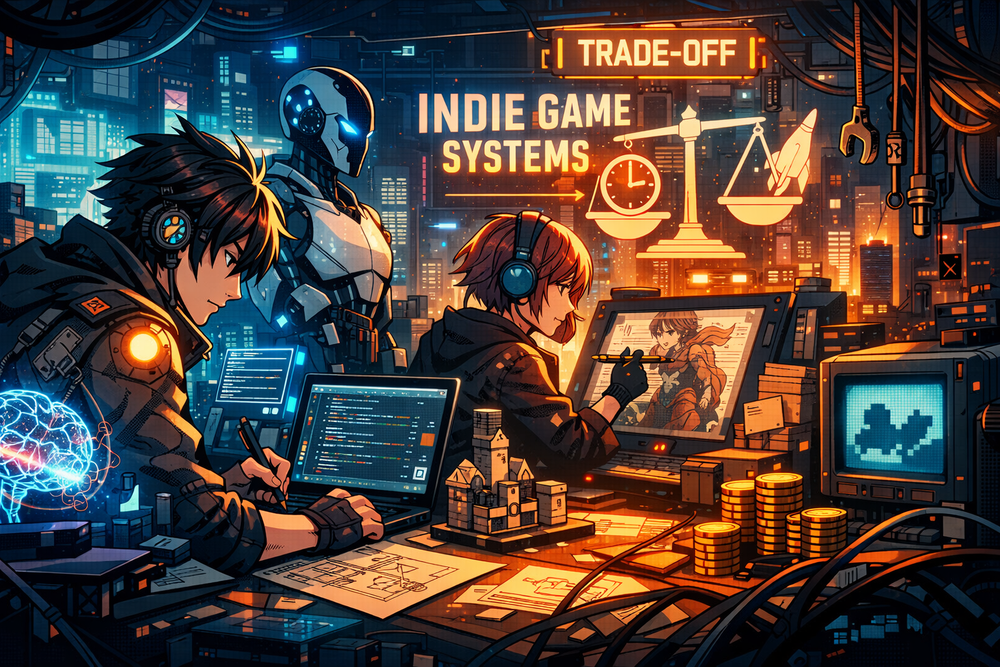
Trade-offs that define modern indie engineering
| Trade-off | What you gain | What you pay | What breaks first if mishandled |
|---|---|---|---|
| Time vs ambition | Richer systems, more content, more polish | Runway risk, burnout risk, opportunity cost | Integration (late-stage), then morale |
| Tools vs identity | Faster production, stability, compatibility | Constraint on aesthetics/workflow, dependency risk | “Generic” feel or engine-shaped design |
| AI vs craft | Faster iteration, more drafts, wider exploration | Editing burden, coherence debt, trust/provenance overhead | Consistency and taste (players notice) |
These trade-offs mirror the realities of self-funding prevalence, solo/generalist workload distribution, and AI-era policy formalization rather than a romantic “more freedom” narrative.
Choosing what not to simulate
Indie is the art of the excluded variable.
The decisive creative act in indie engineering is not maximal simulation. It is the explicit choice of what not to simulate—what to represent instead of model, what to abstract, what to fake with UI, what to collapse into a rule of thumb, and what to cut even if it is “cool.” This is not only aesthetic discipline; it is survival under asymmetric resources.
Two production anecdotes show this principle in action:
- In Factorio’s tutorial design reflections, the dev blog discusses choosing design constraints, selectively removing tools to reduce complexity (even if it increases immediate difficulty), and structuring learning around core concepts—explicitly distinguishing complexity from difficulty and engineering the learning environment as part of the product.
- In Dwarf Fortress engineering discussion, trade-offs appear as constraints on what can be globally optimized (e.g., pathfinding overlays that fail because the world changes too much, or additional indices that impose memory/speed costs). The “what not to simulate” decision is often “what not to compute globally.”
The anti-mythology takeaway, stated plainly.
Making an indie game today is not a symbolic refusal of the mainstream machine. It is a sustained attempt to engineer a coherent system—design, code, content pipeline, and shipping compliance—while operating under asymmetric resources and high market throughput. AI does not remove this; it increases the number of moving parts and the need for boundary decisions. The most “indie” act, in the end, is not maximal freedom. It is the disciplined choice of constraints: choosing what not to simulate so the simulated world can actually ship.