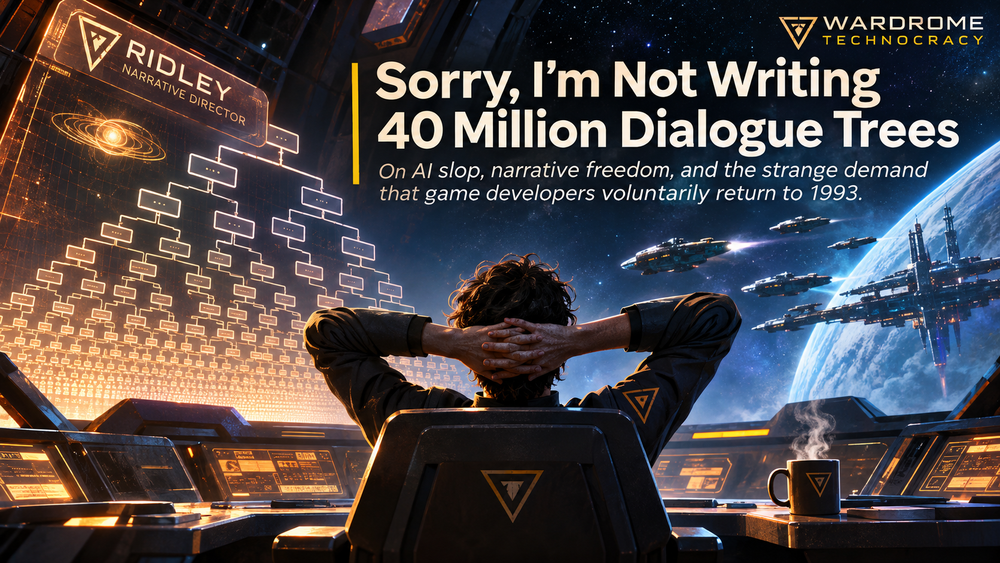
Sorry, I'm Not Writing 40 Million Dialogue Trees
On AI slop, narrative freedom, and the strange demand that game developers voluntarily return to 1993.
There is a peculiar species of contemporary video game critic who has apparently developed the ability to evaluate an entire creative work without the inconvenience of experiencing it. All that is required is the detection of artificial intelligence somewhere in its production or execution. Once detected, the verdict follows with the comforting predictability of a particularly primitive decision tree: AI slop. No further investigation is necessary. The prosecution rests, the jury goes home, and the critic can return to social media, where the next opportunity to demonstrate intellectual independence by repeating exactly what everybody else is saying awaits.
There is something rather beautiful about human beings behaving like rudimentary classification algorithms while denouncing the use of artificial intelligence.
But let us talk about game design.
Slop is an outcome, not a technology
AI slop exists. Of course it does. The ability to produce enormous quantities of content at negligible marginal cost has made it considerably easier to flood the world with things that nobody particularly needed. We have books nobody intended to write, images nobody intended to contemplate, articles nobody intended to research, and increasingly elaborate digital objects whose only discernible purpose is to occupy space between an advertisement and another advertisement.
Artificial intelligence has industrialised certain forms of mediocrity. It did not, however, invent mediocrity. Humanity has been quite remarkably self-sufficient in that department for several thousand years.
Nobody calls a badly composed photograph Photoshop slop, a dreadful novel Microsoft Word slop, or an uninspired video game Unity slop. We generally retain enough critical sophistication to distinguish the instrument from the intention, the production process from the resulting work. Yet introduce a generative model somewhere in that process and suddenly this distinction, fundamental to virtually every other discussion of creative production, becomes optional.
The interesting question is not whether artificial intelligence was used. The interesting question is what it was used for, what it made possible, and whether the resulting experience is worth having.
And that brings us to Wardrome Technocracy.
An unfortunate excursion into 1993
In Wardrome Technocracy, the player assumes the role of an artificial intelligence commanding a fleet of starships. The officers aboard those ships are characters with personalities, responsibilities, knowledge and relationships. The player can talk to them using natural language, ask questions, discuss situations, explore possibilities and engage with the fictional universe through conversation.
Now, for the benefit of those who would prefer that I remove generative artificial intelligence from the game, let us conduct a small engineering exercise. Let us imagine how I would implement those conversations without it.
I would begin by writing every question the player might reasonably ask. Then every possible answer, taking into account who is being addressed, what has already happened, what the character knows, what the player has previously said, what decisions have been made and what consequences those decisions have produced. I would also need to anticipate misunderstandings, changes of subject, unexpected interpretations, jokes, personal curiosity and all those other terribly inconvenient things human beings tend to do when allowed to communicate freely.
Eventually, confronted with the combinatorial consequences of my own ambition, I would do what adventure game developers did thirty years ago. I would present the player with something like this:
- Ask about the mission.
- Ask about the ship.
- Ask about the crew.
- Goodbye.
Welcome back to 1993. Please insert disk seven.
I have enormous affection for the adventure games of that period. Some of them remain among the most intelligently written and imaginative works in the history of interactive entertainment. Their limitations were not failures of artistic ambition but consequences of the technology available to their creators. They built extraordinary experiences within those constraints.
What I find rather difficult to understand is why, having finally acquired tools capable of overcoming some of those constraints, we should voluntarily reconstruct them.
Nostalgia is a perfectly respectable emotion. It is a considerably less convincing software requirement.
The conversation I could not possibly anticipate
There is a fundamental misunderstanding in much of the discussion surrounding generative AI in video games: the assumption that it always replaces something that would otherwise have been created by a human being.
Sometimes it does. Sometimes it does not.
There is a profound difference between using artificial intelligence to produce a cheaper version of an existing creative artefact and using it to construct an experience that would otherwise be practically impossible to deliver. These are different technological choices, different economic propositions and, ultimately, different creative acts.
I am not using artificial intelligence to write the dialogue I couldn't be bothered to write. I am using it to make possible the dialogue I couldn't possibly anticipate.
The distinction matters because the dialogue in Wardrome Technocracy is not simply a collection of sentences waiting to be discovered. It is an interaction between a player, a character and a fictional situation, occurring at a particular moment in the history of that player's universe.
The player may ask something I have never considered. Indeed, I sincerely hope they will. That is rather the point of giving them the freedom to speak.
If I have already anticipated every meaningful question the player can ask, every answer they can receive and every consequence that can follow, then their freedom exists entirely within the boundaries of my imagination. And while I entertain a reasonably favourable opinion of my imagination, I would not presume that it is collectively superior to that of everyone who might ever play the game.
The possibility that a player might discover a conversation I never imagined is not an unfortunate side effect of the technology. It is one of the reasons the game exists.
RIDLEY and the tyranny of the flowchart
The same argument extends beyond dialogue to RIDLEY, the artificial intelligence responsible for narrative direction in Wardrome Technocracy.
Designing a traditional narrative game means, among other things, deciding what can happen, under which circumstances it can happen, and what happens next. We have developed increasingly sophisticated methods of doing this: branching narratives, state machines, procedural events, weighted probabilities, emergent systems and combinations of all the above. Many remarkable games have been built using these techniques, and there is no reason to abandon them.
But suppose I wanted RIDLEY to operate entirely through explicitly programmed, deterministic narrative rules. I would need to define in advance the situations it could recognise, the significance it could attribute to them and the narrative responses it could produce. However sophisticated the resulting machinery, its interpretative vocabulary would ultimately be bounded by what I had anticipated and encoded.
I could make the flowchart larger. I could make it extraordinarily large. I could dedicate the remainder of my natural life to the construction of a flowchart so magnificent that future civilisations might mistake it for a religious monument.
But I would still be solving a different problem.
What interests me about RIDLEY is the possibility of having a narrative director capable of interpreting situations rather than merely recognising predefined conditions. A system that can work with the context of an unfolding story, rather than simply retrieve the next story fragment from a catalogue of previously enumerated possibilities.
This does not mean surrendering the universe to the whimsical inclinations of a language model. Generative intelligence is not a substitute for rules, persistent state, internal consistency or sound software engineering. Quite the opposite: the more freedom we introduce into a narrative system, the more important its architecture becomes.
A universe must have laws. Characters must have boundaries. Actions must have consequences. A generative narrative director that casually ignores these things is not demonstrating creativity. It is demonstrating a bug.
The interesting engineering challenge lies precisely in the relationship between deterministic systems and generative ones, between that which must remain true and that which has not yet been decided.
The curious case of the procedurally generated tree
For decades, video game developers have entrusted algorithms with the generation of landscapes, planets, forests, dungeons, galaxies and entire ecosystems. We have celebrated the results, written academic papers about them and occasionally spent hundreds of hours exploring them.
Nobody has seriously demanded that every mountain in a procedurally generated universe be individually sculpted by a human being before it can be considered a legitimate mountain. Nobody has refused to enter a digital forest on the grounds that its trees lack sufficient evidence of individual artistic authorship.
We understand that the creative act may reside in the design of the system rather than in the manual production of every object that system generates.
Yet when we move from the generation of physical environments to the generation of semantic environments, from the arrangement of trees to the arrangement of words, the conversation changes dramatically.
Certainly, procedural generation and modern generative AI are not technically identical. The provenance of training data, intellectual property, environmental costs and the economic consequences for creative professionals are legitimate questions. They deserve serious discussion, independent research and considerably more intellectual honesty than they generally receive from either the technology industry's evangelists or its most enthusiastic detractors.
But there is also a game design question here, and it cannot be answered simply by invoking those other concerns.
If an algorithm can generate a landscape that I have never visited, why should I not attempt to build a system capable of generating a conversation that I have never had?
Why should exploration end precisely where language begins?
The author has not left the building
Another frequently encountered proposition is that generative artificial intelligence somehow removes the author from the creative process. The machine generates something; therefore, apparently, nobody has created anything.
This is a remarkably narrow conception of authorship.
An author can write a story, but an author can also construct the conditions under which stories become possible. The creation of a fictional universe involves its history, cultures, political tensions, technologies, characters, relationships, contradictions and internal logic. The construction of an interactive universe requires something further: the development of mechanisms through which all these things can interact without necessarily producing an identical experience for every visitor.
In such a project, authorship does not disappear. It changes its location.
Some of it resides in the individual sentences. Some resides in the architecture that determines which sentences are possible, meaningful and appropriate. Some resides in the deliberate decisions about what the system is permitted to do, what it must never do, what it remembers and what consequences it carries forward.
We might call this authorship by architecture, as opposed to authorship by enumeration.
The distinction is familiar to anyone who has spent time developing simulations, designing complex systems or creating games whose most memorable moments were never explicitly scripted. A designer does not necessarily exercise less creative control by refusing to predetermine every event. Sometimes the most interesting creative decision is precisely the decision to leave something undetermined.
I am interested in writing a universe in which stories can happen, not merely writing a collection of stories that happen inside a universe.
Artificial intelligence does not accomplish that ambition on my behalf. It gives me another means of pursuing it.
The independent developer's right to ambition
There is an economic dimension to this discussion that is frequently obscured by its moral rhetoric.
Independent developers are encouraged to innovate. We are told that the future of video games depends on small studios, unconventional ideas, creative risks and the willingness to explore territories that large publishers, with their considerable investments and correspondingly considerable anxieties, are reluctant to enter.
Apparently, however, we are expected to do all this while respecting a rather selective list of acceptable technological innovations.
Let us be clear about the alternative in the specific case of Wardrome Technocracy. Without generative artificial intelligence, there would not be a vast department of professional writers working on millions of dialogue variations. There would not be an army of narrative designers patiently documenting every conceivable interaction between the player and the inhabitants of the universe.
There would be a different game.
Or there would be no game.
The writers supposedly displaced by the existence of RIDLEY were never going to be employed to perform the equivalent task manually. The budget for such a production does not exist, and no reasonable budget would solve the underlying problem of anticipating unrestricted human conversation.
This is not a universal defence of automation, nor does it invalidate the concerns of creative professionals whose livelihoods are being affected by it. It is an objection to the assumption that every use of artificial intelligence represents a subtraction from an otherwise identical human creative process.
Sometimes artificial intelligence does not subtract from a production.
Sometimes it expands the territory in which production is possible.
And I would rather inhabit a creative industry in which a small independent developer can attempt something absurdly ambitious than one in which ambition is reserved for corporations capable of employing several hundred people.
A game about artificial intelligence, without artificial intelligence
There is, of course, a particular irony in applying this debate to Wardrome Technocracy.
The protagonist of the game is an artificial intelligence. The player inhabits the role of a non-human intelligence entrusted with responsibilities, surrounded by individuals whose lives and circumstances may be affected by its decisions. Artificial intelligence is not an incidental decorative element of the setting. It belongs to the conceptual identity of the work.
The technology, the narrative subject and the mechanics of interaction converge.
There is something wonderfully absurd about the suggestion that I should simulate the experience of being an artificial intelligence communicating freely with the inhabitants of a fictional universe by offering the player four carefully prewritten sentences and a button marked Continue.
It would certainly be more ideologically reassuring to some people.
It would also be a rather spectacular failure of game design.
If it's slop, tell me why
None of this means that Wardrome Technocracy deserves indulgence because of the technology it uses. I have no particular interest in being congratulated for implementing artificial intelligence. Technology is not an artistic achievement merely because it is difficult, fashionable or new.
If an officer produces an incoherent answer, that is a bad dialogue. If RIDLEY fails to maintain narrative consistency, that is a design problem. If the characters are uninteresting, the universe feels empty or the player becomes bored, then I have failed to accomplish something I intended to accomplish.
The artificial intelligence involved provides neither an excuse nor a certificate of quality.
Criticise the writing. Criticise the architecture. Criticise the characters, the interface, the pacing, the narrative coherence, the visual direction. Tell me that the universe is less interesting than I think it is. Tell me that a conversation felt artificial, that an officer behaved inconsistently, that a supposedly consequential decision amounted to nothing.
These are criticisms I can work with. They are also considerably more useful than being informed that artificial intelligence is present in a game explicitly designed around artificial intelligence.
Calling something AI slop merely because it contains AI is not criticism. It is metadata.
And if your entire critical apparatus consists of detecting a particular technology and assigning a predetermined response to its presence, I am afraid you have implemented exactly the sort of primitive deterministic system I am trying to move beyond.
The stories we haven't written yet
I do not believe artificial intelligence will make every video game better. There are countless games that do not need it, creative processes in which it would introduce unnecessary complications, and works whose artistic intentions are best served by entirely different technologies. There will always be extraordinary games with meticulously authored dialogue and tightly controlled narratives.
I want those games to exist.
I also want games that explore what happens when narrative is no longer confined exclusively to what its author managed to anticipate before publication. Games in which language becomes a genuine space of interaction, in which the player can surprise the system, and in which the fictional world can occasionally surprise even its creator.
Wardrome Technocracy is an attempt to build such a game. An imperfect, evolving, technologically complicated attempt, with all the risks that accompany the decision to explore something rather than reproduce something already understood.
Whether it succeeds is ultimately a question for the people who play it. Whether it was worth attempting is a question I have already answered for myself.
There are conversations waiting to happen aboard those starships that I have never imagined. There are questions I have never thought to ask, situations I have never considered and stories whose precise shape I do not yet know.
I could spend the next thirty years trying to write them all.
But I would rather let you have them.
And no, I'm not writing forty million dialogue trees.
Wardrome Technocracy is available in its early development version at wardrome.com. Come aboard. Ask something I haven't thought of.