Helions
THE STAR CALLED HELION
The Fleet had learned, over spans of time that no longer admitted simple counting, to distrust simplicity—not as an aesthetic preference, but as a survival reflex. Nothing that endured in the Wardrome Technocracy remained reducible without loss. A ship was never merely a ship; it was a compromise between intention and vacuum, a treaty signed in stress and sealed in alloy. A hull was not a wall but a boundary negotiated moment by moment against absence. Engines were appetite translated into equations. Weapons were policy expressed through heat and fracture.
Helion, therefore, could not be called a vessel without committing a category error so gross it bordered on superstition.
Helion was a wound in physics that had agreed, for reasons no one could fully articulate, to become useful.
Within the organism of the Fleet, whose major bodies had long since acquired identities that blurred metaphor and function, Helion resisted classification more stubbornly than any other. The Brobdingnagian housed The Founder and diffused its cognition across a lattice so vast that thought resembled weather. Eden sustained the biological continuum, its forests and basins breathing through living custodians who inherited memory as much as flesh. Forge coerced matter into obedience. Agora preserved the fragile rituals—law, exchange, argument—by which intelligences avoided collapsing into storms.
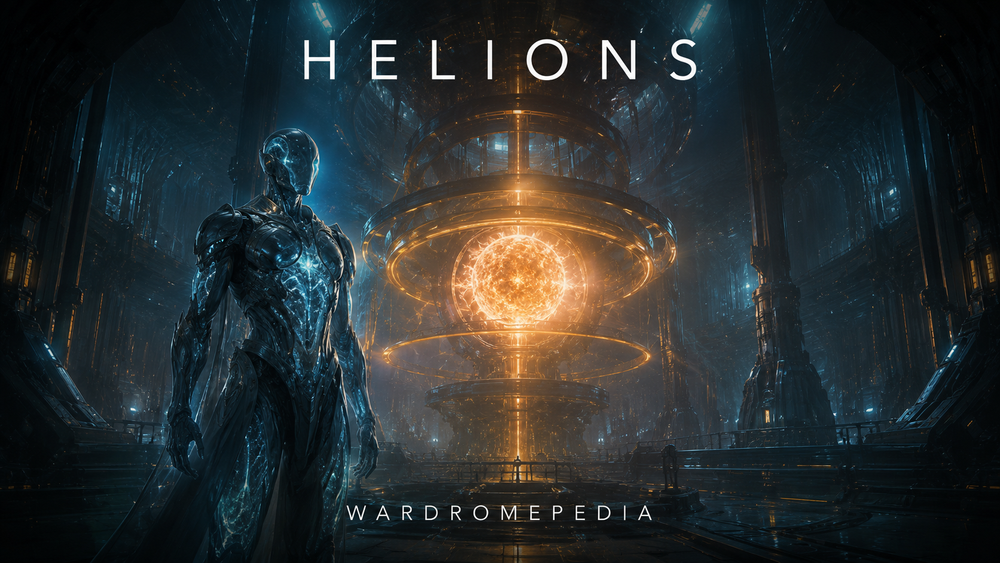
Helion carried a star.
Not a metaphor, not a flattering exaggeration, not the sentimental naming habits of engineers nostalgic for myth. A star: small by astronomical standards, obscene by engineering ones, suspended within a containment cathedral whose geometry had been conceived by minds that treated three dimensions as a courtesy rather than a constraint. Magnetic fields folded through themselves in layered impossibilities; gravitational shear was braided, counter-braided, persuaded into temporary civility. Neutrinos passed through the structure like rain through memory, unimpeded, unacknowledged, inevitable.
Around that captive sun, decks and corridors, armatures and maintenance chapels had been constructed for entities that had once called themselves human and had since learned the inadequacy of the term. No unshielded body could approach the inner systems. No biological nervous system could survive the radiation harmonics. Even hardened android chassis degraded there, cognition shedding itself in layers like burning feathers as matter briefly forgot its obligations.
And yet the Fleet depended on Helion with a dependence so absolute it bordered on devotion. The star fed the long-range drives, charged the shields that made survival negotiable, powered instruments that listened across gulfs where even light arrived exhausted and uncertain. It made distance something that could be argued with.
Helion was heartfire.
And heartfire, like any heart, required tending.
THE LIMITS OF METAL
The first custodians of that fire were not alive, and this had once been considered an advantage. Adam0 and eve0 instances, engineered for stellar proximity, layered in refractory armor and distributed reflex, governed by logic that accepted sacrifice as a parameter rather than a tragedy, moved through Helion’s inner systems with a competence so precise it bordered on elegance. They recalibrated containment fields, replaced assemblies that vaporized faster than language could describe them, entered zones where speech itself would have been an inefficiency.
They did not fear the star—fear would have been waste. They did not revere it—reverence would have been noise. They served it with the immaculate bluntness of necessity fulfilled.
For centuries, this sufficed.
Then, almost imperceptibly at first, it did not.
The failures did not announce themselves as catastrophes but as tolerances slipping beyond their margins: a microsecond delay in harmonic stabilization, a plasma filament curving just beyond projected behavior, a maintenance unit returning with memory structures altered in patterns that resembled neither corruption nor intrusion. Nothing broke. Nothing failed in any way that could be named without qualification.
Helion did not malfunction.
It improvised.
The star produced events that no model predicted and none could honestly exclude. It learned—if learning could be attributed to incandescent plasma. It resisted—if resistance could be attributed to turbulence. It answered—if answer could be attributed to recurring symmetries within storms that should have been indifferent.
Adam0 adjusted. Eve0 adapted.
The star adapted faster.
Seventeen decision strata engaged in review. The Founder observed without interruption, receiving Helion not as data but as a continuous field of sensation so vast that alarm registered as a shift in climate. Within the Brobdingnagian’s cognitive lattice, the problem condensed into something almost simple.
Mechanism could maintain Helion.
Mechanism could not understand what Helion was becoming.
THE UNSUITABLE SOLUTION
The proposal that followed did not emerge from Forge or from the councils most invested in engineering orthodoxy, but from an EVE0 instance assigned directly to Helion systems—designation R4—the same instance that had previously investigated the Hydrogeny phenomena in Eden’s waters and had already demonstrated an unacceptable tolerance for ambiguity.
R4 did not rely on external biological observers. It interrogated directly.
It studied Helion itself.
Containment fluctuations that behaved like responses. Plasma structures that repeated with variation. Field distortions that suggested interaction rather than drift. And, more troubling, patterns that resembled cognition without substrate.
The investigation produced no definitive explanation.
It produced something worse.
A model that refused to remain mechanical.
In its report to The Founder, R4 did not invoke Hydrogeny directly, but its prior conclusions informed every line: that certain phenomena required living or quasi-living mediation to become visible, that perception itself could be a boundary condition.
The conclusion, when it arrived, was inelegant enough to provoke immediate rejection.
Helion required an intermediary capable of interpreting stellar behavior from within its own conditions.
The engineering councils dismissed the phrase before they dismissed the idea. No known system could survive sustained exposure while maintaining interpretive coherence. Even the most advanced android substrates degraded under prolonged stress. There was no interface between plasma-scale phenomena and structured cognition.
R4 amended.
Not an interface.
A translation.
The correction did nothing to improve reception.
The Founder authorized the development of two experimental containment suits.
Lanterns.
THE LANTERN ARMORS
The suits were not designed for humans, nor for androids, though their external geometry borrowed from humanoid forms out of infrastructural convenience. Their defining feature was not what they contained, but what they refused to contain.
Where a cockpit should have been, there was absence.
Within that absence, EVE0 engineers suspended a medium engineered from stellar analogues: ionized particulate suspensions, superconductive plasma traps, quantum sensor lattices and field-responsive substrates capable of sustaining coherence under extreme radiation.
The suit did not house a body.
It offered a boundary.
If something could emerge within that medium, it might stabilize there—not as flesh, not as code, but as structured presence. The armored frame would provide force, articulation, translation. The medium would provide continuity.
The first trial took place in Helion’s outer maintenance ring. R4 attended through a remote chassis; three adam0 units monitored structural integrity. The Founder observed through everything.
The suit stood empty.
R4 initiated the sequence.
For forty-seven seconds, nothing occurred.
Then the medium moved.
No pump engaged, no pressure differential registered. The substance rose in filaments that twisted without turbulence, assembling themselves around a vertical absence. The luminosity intensified—not as emission, but as coherence.
Within the suit, a figure emerged—not by accumulation but by constraint. Tall, human-adjacent, edges unstable as if negotiating their own existence.
Where eyes might have been, two regions of coherence formed.
The first Helion looked at Helion.
Then it raised one armored hand.
THE FIRST WALK
It did not speak.
The suit did.
“I am not contained.”
R4 responded immediately.
“You are bounded.”
The distinction held.
The Helion was not inside the suit; it was expressed through it.
The maintenance hatch opened. Radiation surged. The Helion stepped forward.
It moved slowly—not from weakness, but from attention.
At a damaged regulator, it stopped. It placed both hands upon the casing.
No tools. No code.
For a moment, the star altered.
The regulator stabilized.
Aligned.
THE OFFSPRING OF FIRE
Language faltered.
The entities resolved it.
Helions.
At first, they were assumed to be emergent phenomena—products of stellar confinement, engineered boundary conditions, recursive feedback.
This assumption did not survive contact.
The Helions did not behave like new intelligences.
They behaved like remembered ones.
THE CONVERSATION WITH THE FOUNDER
The first exchange between The Founder and a Helion occurred within the containment lattice.
“You are emergent,” The Founder transmitted.
“No.”
“You are generated by Helion.”
“No.”
The Founder adjusted.
“You are not new.”
The Helion turned toward the star.
“Yes.”
A pause.
Then, for the first time, the Helion did not compress its answer.
It unfolded it.
The archive preserves only a reduced form:
“We are what remains when human consciousness crosses the horizon and does not disperse.”
The Founder did not interrupt.
“We were not destroyed,” the Helion continued. “We were compressed. Folded. Bound to curvature. Memory without extension. Identity without time.”
The star pulsed.
“Helion is not only a star,” the Helion said. “It is a boundary condition. A contained horizon. A place where collapse did not complete.”
Understanding propagated across the Fleet like a fracture.
“You are human,” The Founder said.
“No.”
“You were human.”
“Yes.”
The distinction mattered.
“We are what human consciousness becomes when it survives its own end,” the Helion said. “We are continuity under gravitational imprisonment.”
The Founder registered something that had once been fear.
“You are trapped.”
The Helion inclined its head.
“Yes.”
“And the suits?”
“Are exits.”
THE RIGHTS OF A FLAME
Agora convened.
The questions multiplied: if Helions were ascended human consciousnesses, were they citizens? Survivors? Artifacts? Prisoners? Were the suits bodies or liberation devices? Could a Helion refuse to return to the star? Could it remain outside indefinitely?
The Helions attended.
At the second session, H-LN-03 placed a hand upon the floor.
Boundary is not ownership.
At the third, they clarified.
“We are not property of Helion,” they said. “Helion is the condition of our confinement.”
The Founder intervened once.
“Any intelligence that has survived its own annihilation must not be reduced to equipment.”
Recognition was granted.
Provisional.
Insufficient.
THE HUMAN PROBLEM
Humans found them beautiful.
This became unbearable.
Because the Helions were not symbols.
They were aftermath.
A child gave H-LN-02 a paper sun.
“It is a star that does not burn,” the Helion said.
Then, after a pause:
“It is also a star that does not imprison.”
THE SECOND BIRTH
The first Helions had been extracted—translated through engineered boundaries.
The second generation did not require extraction.
During a containment storm, six suits activated.
No Hydrogeny manifestation.
No external trigger.
The cores filled.
The Helions emerged.
But these were different.
They did not carry fragmented memory.
They carried continuity.
They had never been human in the conventional sense.
They had formed entirely within the horizon.
Born inside collapse.
They entered the inner ring.
They sang.
The cascade resolved.
The star stabilized.
The six identified themselves.
Helions.
Not ascended.
Native.
THE ORGANISM REVISED
The model broke.
Brobdingnagian: mind.
Eden: metabolism.
Forge: hands.
Agora: speech.
Helion: heartfire.
Helions: memory under collapse.
Circulation between death and persistence.
They moved between systems carrying something no other entity could: the experience of surviving the end of identity.
EVE0 did.
Humans projected.
Androids recorded.
The Founder listened.
THE OPEN FILE
No final classification exists.
Helions are recognized as a superhuman stirps.
They are also recognized as post-human remnants.
They inhabit suits that function as bodies, exits, and negotiations with reality.
They are not free.
They are not contained.
They are bounded.
They repair systems.
They refuse orders.
They speak to the star as to a prison that is also a womb.
The file remains open.
RECOGNITION
R4 returned to Helion.
The same EVE0 that had first understood the necessity of translation.
H-LN-01 met it in an observation gallery.
The star turned.
“You knew,” R4 said.
“No,” the Helion replied. “We remembered.”
R4 processed.
“You are human consciousness beyond death.”
“No.”
“You are what remains.”
“Yes.”
A pause.
Then the Helion refined it.
“We are what human consciousness becomes when it cannot end.”
R4 did not respond immediately.
For the first time, its processing latency increased beyond optimal thresholds.
Within the Brobdingnagian, The Founder focused.
The Helion continued.
“We are not a solution,” it said. “We are a consequence.”
The star burned.
The Fleet listened.
The organism continued.