Global Mobile Gaming Trends 2025: East Meets West in Play and Pay
Daily Play, Different Ways: Loyalty and Play Patterns by Region
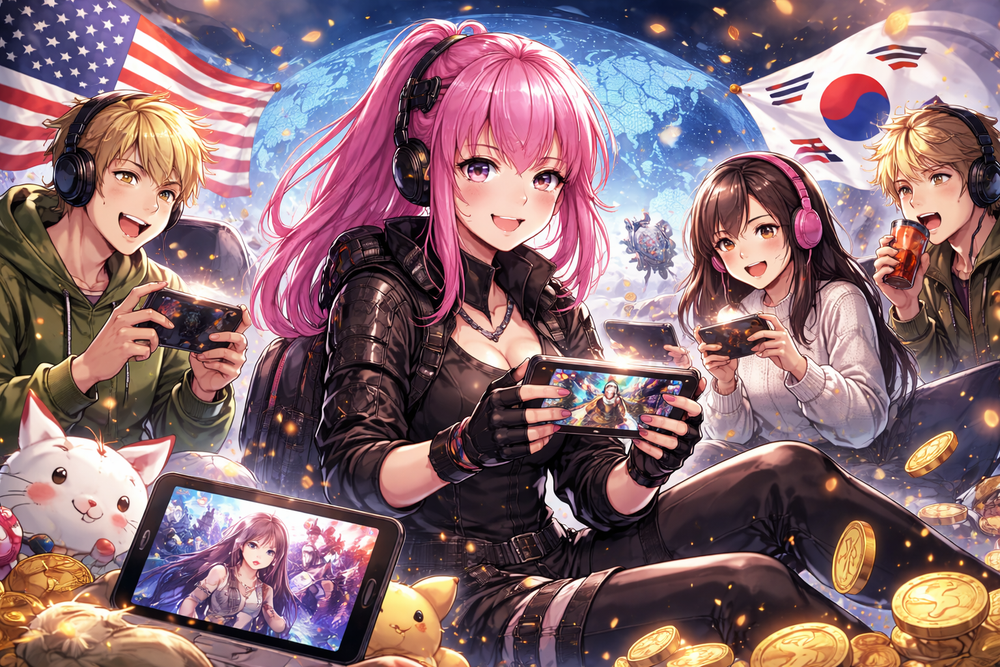
Mobile gaming has become a daily ritual for the vast majority of players worldwide. In fact, over 85% of mobile gamers in major markets play every day, often multiple sessions per day. But how they play varies greatly between East and West, revealing a deep divide in player loyalty and game rotation.
- United States & UK: Gamers in Western markets tend to spread their attention across many titles. A majority of U.S. (around 63%) and U.K. players (62%) play four or more different games each week, hopping between a larger library of games. This “game-hopping” habit suggests that capturing a download in these markets might be easier than keeping long-term loyalty – players are quick to try the next new thing. As one industry report put it, Western gamers’ brand attachment is shallower, which can mean higher churn if a game doesn’t continuously captivate. The flip side is that Western audiences offer breadth: an indie title can more readily attract some attention, even if for a short time, as players frequently explore new experiences.
- Japan & South Korea: In East Asia, commitment runs deeper. More than half of Japanese players (about 52%) and an even larger 67% of South Korean players stick to just 1–3 core games in a typical week. These gamers invest most of their time in a select few favorites, indicating a fierce loyalty once a game earns their devotion. The barrier to entry for new games is higher – why install a new app when you’re deeply engaged in an existing one? But if you do win them over, these players can stay for the long haul. As one mobile CEO noted, loyalty in the East “has to be earned before it can be kept,” and it’s hard-won but powerful. For developers, this means Asian markets reward depth: games that provide ongoing content, narrative, and community to keep players hooked will thrive, whereas shallow experiences might struggle to break players away from their beloved titles.
The East–West split in play patterns is a crucial context for any developer going global. Western audiences might give your game a quick try – a double-edged sword that means easy come, easy go. Eastern audiences won’t download as readily, but if they do, they’re more likely to integrate the game into their daily routine long-term. As a result, retention strategies must diverge: in the U.S. and U.K., the challenge is maintaining interest among “game grazers” who have many choices, while in Japan and Korea the challenge is earning trust and loyalty to become one of the few go-to games in a player’s life. It’s a reminder that a one-size-fits-all approach to user acquisition and retention will fall flat – successful studios increasingly “think globally, but act locally” by tailoring design and engagement to these habits.
Hyper-Local Discovery: In-App Ads vs. App Stores (and why facebook works in the west)
How players discover new games in 2025 also varies dramatically across regions. The channels that work for user acquisition in one country may barely register in another. The key distinction lies between discovery driven by in-app advertising (often on social media) versus discovery via local app stores and native platforms.
- United States & UK – Social Media and In-App Ads: In Western markets, social networks reign supreme for game discovery. A recent industry survey found that over three-quarters of mobile gamers in the U.S. (77%) and U.K. (79%) mainly discover new games through social platforms and their ads, with Facebook being the standout channel. Scrolling through Facebook or Instagram, players encounter game ads tailored to their interests – and these ads are clearly working as a primary funnel. Instagram also plays an influential role (around 37% of U.S. and 45% of U.K. players cite it). Even streaming platforms like Twitch and YouTube factor into Western discovery, as gamers often see highlights or influencer content there and learn about new titles. The dominance of Meta’s platforms suggests that, in the West, you effectively need a social media presence or ad campaign to get on gamers’ radar. Word-of-mouth on Reddit or Discord can also boost discovery in niches, but paid social reach is king. The good news for indies: a clever ad on Facebook can theoretically reach millions of potential players in the West – but it also means you’re competing in a very crowded, algorithm-driven attention economy.
- Japan & South Korea – App Store Browsing and Local Platforms: In East Asia, players are more inclined to find games organically through app store exploration or local community hubs than through generic social feeds. In Japan, 53% of players rely heavily on browsing the Apple App Store or Google Play storefronts for new games. They often watch the top-ranking charts, new release sections, and editorial features in their local language. Similarly, 46% of Korean gamers find games by searching the app stores or through homegrown channels. For example, Korea’s own One Store (an Android app marketplace) and popular portals like Naver can drive awareness. Korean gamers also pay attention to local game news sites and forums – communities like DC Inside and official game cafes – where new releases get discussed. In Japan, Twitter (rebranded as X) is huge in the gaming conversation, and trending game topics or retweets from popular Japanese gaming accounts can spark interest more than a Facebook ad would (Facebook has relatively low usage in Japan). In short, discovery is hyper-local in Asia: you succeed by being visible in the native app ecosystem and conversation. App store optimization, local press coverage, and buzz in gamer communities are far more impactful in Japan/Korea than a blanket social media campaign. It’s telling that a significantly smaller fraction of Japanese and Korean players mention platforms like Facebook for discovery – those Western channels just don’t penetrate as deeply.
For developers, these discovery differences mean marketing strategies must adapt regionally. A Western indie studio might focus on Facebook Ads, influencer partnerships on Twitch/YouTube, and cross-promotion within other apps to drive installs. But to win in Japan or Korea, one might invest more in app store featuring, localization quality (to get good reviews), pre-registration campaigns, and tie-ins with local platforms. Even something as simple as getting featured on Google Play Japan with strong localized screenshots and gameplay videos can make or break your discoverability there. The bottom line: meet players where they are. In the West, that’s scrolling through social feeds; in the East, it might be scrolling through the app store or reading local gaming forums.
Influencers and Pre-Install Research: The new Word-of-Mouth (Especially in Asia)
Discovery isn’t just about stumbling onto an ad or an app store listing – it’s also fueled by word-of-mouth and research, and here again we see a cultural split. In 2025, influencers, streamers, and gaming communities play an outsized role in shaping which games people even consider installing, particularly in Asia. Savvy gamers do their homework before hitting “download,” and indie developers need to be aware of this pre-install journey that differs by region.
Western vs. Asian “Hype” Cycles: In the West, some players will check Reddit threads, YouTube reviews, or ask friends about a game, but a large portion are comfortable just trying a game on a whim (especially if it’s free). If the ad looks fun or the App Store screenshots are appealing, an American or British player might give it a shot immediately. Influencers in the West do have pull – for example, a popular Twitch streamer showcasing a new indie title can send a flood of interest (as seen when streamers created breakout hits out of titles like Among Us or Vampire Survivors). However, Western gamers are slightly less deliberate on average; impulse installs are common because there’s less perceived commitment (and perhaps because attention spans are shorter when so many games are vying for time).
In Asia, by contrast, players often treat installing a new game as a bigger decision – one that warrants gathering information. It’s not unusual for a Japanese gamer to first watch gameplay clips on YouTube or Twitter, or for a Korean player to read through community forum discussions, before downloading. This makes sense given the loyalty factor: if you typically devote yourself to just a couple of games, you want to ensure the next one is really worth it. Influencers and content creators are therefore key gatekeepers. For instance, in Japan, many mobile gamers follow YouTubers or VTubers who specialize in showcasing new gacha games; a positive preview or “Let’s Play” from a trusted creator can make thousands of fans confident to pre-register for a game. South Korea similarly has prominent gaming YouTubers and streamers (on AfreecaTV or KakaoTV) whose opinions carry weight. A common scenario in Korea is a well-known streamer getting early access to a game and viewers deciding on day one installs based on that first look.
Even beyond individual influencers, community consensus matters in Asia. Japanese players might check Twitter trending topics to see if a game is generating buzz or look at the App Store reviews (which Japanese users notoriously write in detail) to gauge quality. Korean gamers often join official Naver Cafe fan communities for a game during its pre-launch to see announcements and peer opinions. In these ways, the social proof and information-gathering step is ingrained in the player journey.
Pre-Registration Mania: One concrete manifestation of this research-oriented approach is the prevalence of pre-registration campaigns in Asian markets. Major game launches in Asia routinely rack up millions of pre-signups. For example, the Chinese open-world RPG Where Winds Meet hit a whopping 5 million pre-registrations worldwide ahead of its late-2025 launch, including a huge chunk in East Asia, reflecting how players were following the game’s development closely. In fact, by the time it officially launched in China, it already had 30 million players signed up from earlier waves. This kind of massive pre-launch engagement is far more common in Asia – it’s both a marketing tactic and a sign that gamers like to commit early to games they believe in (often enticed by promised rewards for hitting pre-reg milestones). Western launches are slowly adopting pre-reg (Google Play supports it), but nowhere is it as critical as in Asia. An indie developer planning to launch in Japan or Korea should consider a pre-registration campaign with local platforms, because many players will expect to hear about the game before it’s out and see a community forming around it.
The Influencer Effect: Whether it’s East or West, 2024–2025 has underscored that authentic voices can amplify a game’s reach. We’ve seen games like Genshin Impact collaborate with fast-food brands and enlist influencers to expand reach in Asia, and Western titles like Fortnite continue to use influencers (and even become influencers themselves in pop culture) to stay in the spotlight. But especially for indie studios without massive ad budgets, tapping into the influencer network is gold. The key is choosing the right platform for the region: maybe a TikTok campaign for the U.S. (short, viral-focused content), a YouTube series for Japan (where longer-form reviews and anime-style hype can work), or a Twitch sponsorship for core gamers in the U.K. and U.S. If your game has strong meta or competitive play, streamers in any region can help pull in the curious competitive crowd. If it’s story-rich, you might benefit from YouTubers who do narrative playthroughs that get viewers invested in the plot before they even play (a tactic particularly potent in story-loving markets like Japan).
In summary, the path to install is increasingly social and research-driven. Developers should assume that a good chunk of players – particularly in Asia – will have heard something about your game, watched something about it, or read user opinions before they ever give it a download. Cultivating positive buzz through creators and early community engagement is as important as any ad campaign, if not more so, when it comes to building a sustainable player base that trusts your product from day one.
From Fake Ads to Gameplay Trailers: Why authenticity matters more than ever
Mobile game advertising has a notorious reputation for sometimes being… less than truthful. We’ve all seen those ads: the puzzle game ad that shows a completely different gameplay than the actual app, or the strategy game ad with graphics far better (or stranger) than reality. For years, these misleading ads proliferated because, frankly, they worked to get cheap installs. But in 2024–2025, the industry is facing a reckoning: players have grown wary and weary of fake ads, and the importance of authenticity and real gameplay footage in marketing is at an all-time high. Getting players to install your game is only half the battle – keeping them from churning in disgust is the other half.
Installs at any cost? The Short-Term lure vs Long-Term backfire: There’s no denying that outrageous or misleading ads can generate a quick spike in downloads. Those over-the-top ads promise something crazy and different, and curious users tap the install button out of sheer intrigue (or FOMO). Games like Evony and Homescapes became infamous case studies – their ads showed wild puzzles or battle scenarios that only loosely reflected the actual gameplay, yet they attracted millions of installs. In the short run, such “fake ads” drive lots of low-cost CPI (cost per install), a metric growth hackers love. However, there’s a growing body of evidence that this approach carries steep hidden costs. A survey on player sentiment found 58% of players will quit a game immediately if the ads that led them there were disruptive or deceptive, and a whopping 84% will uninstall after repeated bad ad experiences. That means even if you got the install, you’ve basically paid to acquire a user only to turbo-charge their churn. Worse, you may have poisoned your studio’s reputation in that player’s eyes.
Players talk, too – misleading advertising can lead to negative word-of-mouth and scathing reviews (“Not like the ads!” appears in many app store review sections these days). It’s a fast way to blow your brand equity. As PocketGamer.biz bluntly put it, these short-term tactics boost installs but “the cost to brand equity and player loyalty is becoming too steep to ignore”. In an era where switching games is easy, trust and goodwill have become vital assets. If a player feels tricked, they’ll not only quit; they likely won’t come back or try your next title either.
Authenticity Wins (and the Rise of Gameplay-Focused Ads): On the flip side, developers and marketers are increasingly finding that honest, gameplay-centric advertising pays off in the long run. Ads that actually show your game – real footage of real gameplay – tend to attract players who are genuinely interested in what your game offers, leading to better retention and monetization down the road. A marketing agency analysis noted that genuinely honest ads have staying power and build loyalty, whereas fake ads can lead to lower retention and long-term damage. In 2025, user-generated content (UGC) and influencer-style ads have exploded in popularity, largely because they feel authentic and relatable. These are the ads where someone is actually playing the game or talking about their experience, often filmed in a lo-fi, first-person style (think TikTok videos of a player reacting to a clutch moment, or a streamer-style commentary in a 30-second vertical video). They come across as personal recommendations rather than corporate advertising, which instantly builds more trust with viewers.
Take Monopoly GO! for example: its ads in 2025 featured a likeable millennial guy casually sharing how much fun he had with the game, intercut with actual gameplay footage of the mobile Monopoly board. He’d say things like “If you loved classic Monopoly, you’ll love this” – a simple, authentic pitch from a fellow player. The result? Viewers felt like they got a genuine peek at the game and a friend’s endorsement in one; this “relatable vibe” drove installs by earning the audience’s trust. Similarly, Royal Match ran UGC-style ads where a young player enthusiastically highlighted that the game doesn’t have intrusive ads (imagine that – using “no fake ads” as a selling point!) while showing real gameplay of its puzzles. Such transparency can turn into a selling hook: players fed up with ad-saturated games or misleading tactics see an ad that effectively says “hey, we’re different, we respect your experience.” And many respond positively to that.
Even large companies are shifting. Supercell’s ads for Clash of Clans or Clash Royale have long used humor and authenticity (often showing gameplay or riffing on real player behaviors). And now smaller studios are finding success with straightforward playable ads – short demos that let users try the actual game in micro form. These playable ads are incredibly effective for hyper-casual and casual titles because players know exactly what they’re getting; they self-select in if they enjoy the snippet. Data shows that letting users experience actual gameplay in an ad leads to higher conversion and often more qualified players who stick around.
Churn and Burn (The Player’s Perspective): From the player point of view, the irritation with false advertising has peaked. According to an Interactive Advertising Bureau report, 56% of mobile gamers say they’ve encountered ads that blatantly misrepresent gameplay, which breeds frustration and mistrust. Many of these players now approach new game ads with skepticism. The savvy ones might even avoid games that look like they’re being advertised misleadingly. On the extreme end, some fraudulent ads hide malware or scams, but even the garden-variety fake gameplay trailer is viewed as a “bait-and-switch.” Players often feel the game studio must be lacking confidence in their product if they resort to such tactics. And honestly, who can blame them? If a game shows me an RTS battle with hundreds of troops but turns out to be a base-builder with timers, I feel tricked and quickly hit uninstall.
It’s not just about honesty; it’s also about quality of ads. Intrusive, non-skippable ads, or ads with offensive content, drive users away in droves. Nearly 93% of players will abandon a game that uses deceptive UI tricks like fake “close” buttons on ads. Again, short-term gain (you forced them to see an ad or accidentally click) results in long-term loss (they quit the whole game). Bad ads are literally killing the mobile gaming experience, as one analyst wrote, urging studios to take control of the ad content they allow in their games.
Key Takeaway: For developers, especially indies trying to build a brand, authentic marketing is not just a moral high ground – it’s good business. Show real gameplay, highlight what makes your game fun in truth, and you’ll attract players who are looking for that exact experience. They’ll be happier when they start playing, and more likely to stick around and even spend. Misleading ads might get you a big download count initially, but if those players bounce in a day, what have you achieved besides burning ad budget? In 2025, the mobile audience has matured: they value honesty and reward it with their loyalty (or at least, they won’t punish you with instant churn). As one marketing firm observed after running thousands of campaigns, authenticity wins long-term and fake ads “can deliver low CPI initially, but can lead to negative user feedback, lower retention, and long-term brand damage”. The choice is clear. In a world increasingly skeptical of clickbait, the best advertisement for your game is your game itself – so let it shine.
Keeping Players Hooked: Daily Bonuses vs. Epic Stories (East-West Engagement Styles)
Getting a player to download your game is just the first step. The real challenge is keeping them coming back tomorrow, next week, next month. Here we see one of the most fascinating divergences in global gaming culture: what motivates players to stick with a game (and come back after a break) differs widely between Western and Asian audiences. Developers often use a toolkit of retention tactics – daily login rewards, special events, narrative updates, exclusive items, etc. – but the effectiveness of each lever can hinge on local player preferences.
The West – Routine and Rewards: In the US and UK, mobile gaming often fits into a casual daily routine. Many players treat mobile games as a way to relax or fill small pockets of time (commutes, lunch breaks, winding down in the evening). Thus, they respond strongly to simple incentives and streaks that reinforce making a game a daily habit. The classic example is the daily login bonus: something free every day you open the game. This tactic is almost expected in 2025 – and it works particularly well in the West. Roughly 60% of Western players (US/UK) say daily rewards are a key motivator that keeps them playing a mobile game. The psychology is straightforward: if you know you’ll get a small reward or progression boost just for checking in, you’re likely to pop open the app every day, even if only for a few minutes. Over time, that routine cements the game as part of daily life, and players might then stay longer to actually play a round or two.
Western players also cite relaxation and fun as motivators – these are audiences that lean toward casual genres (puzzle, match-3, idle sim) where gameplay is more about unwinding than high-octane competition. So the games that thrive in the US and UK often emphasize easy drop-in play and steady rewards. Think of games like Candy Crush Saga or Coin Master: they hand out free boosters or spins regularly, nudging you to come back tomorrow for more. Even mid-core Western games layer in reward calendars and bonus events for logging in. It aligns with broader entertainment habits – Western gamers are used to loyalty programs, streaks on Duolingo or Snapchat, and binge-watching streaks on Netflix; the “come back every day” pattern is familiar and comfortable.
Furthermore, when Western players drift away from a game, one of the proven ways to re-engage lapsed users is again – you guessed it – rewards. About 45% of churned players in the West can be enticed to return if you offer them a comeback incentive (like a “we miss you” free reward bundle). This is much higher than in Asian markets. Essentially, dangling some free coins, loot boxes, or power-ups can effectively win back nearly half of the quitters in the West, at least for another look. It’s a testament to how reward-driven the Western engagement loop is.
The East – Immersion and Events: Now contrast this with Japan and South Korea. While Japanese and Korean players enjoy free rewards too (nobody dislikes gifts), these tactics alone are less potent. In Japan, what really hooks players is story and lore. Approximately 47% of Japanese players keep playing because they’re invested in the game’s narrative – they want to see the next chapter, the next character arc, the next piece of the story world. This is a huge differentiator. Culturally, Japan has a long history of story-driven games (RPGs, visual novels) and a media environment rich in serialized storytelling (manga, anime episodes, etc.). Mobile games like Fate/Grand Order, Arknights, or Uma Musume Pretty Derby succeed not just on gameplay but on delivering an ongoing story that players care about. Regular story events or new chapters in these games are treated like content drops that fans eagerly await – comparable to a new episode of a favorite show. So, for a game targeting Japan, focusing on rich characters and an evolving storyline can foster a deep attachment that transcends the grind. It’s not something a simple daily coin can replace.
South Korean players, on the other hand, show a strong affinity for limited-time events and competitive challenges. Around a third of Korean players (32–34%) cite time-limited events as a main motivator to keep playing. This aligns with Korea’s gaming culture, which is steeped in MMORPGs and esports. Players love events that bring the community together – a special dungeon for a holiday, a weekend double XP event, a new ranked season, etc. The fear of missing out (FOMO) on an event’s exclusive reward or the thrill of a live competition drives engagement. Korean hits like Lineage Mobile or Black Desert Mobile constantly run festivals, boss raids, and PvP seasons – there’s always something happening now that you’d regret missing if you’re a dedicated player. Additionally, as noted earlier, Korean gamers are often motivated by status and competition. Events give a chance to prove oneself, climb leaderboards, or earn unique badges/skins that confer prestige. So, engagement in Korea is about participation in a dynamic, social gaming world – a stark contrast to the West’s solitary daily puzzle habit.
Japanese players also love exclusive items and characters – about 31% are drawn by the prospect of obtaining unique in-game items that not everyone can get easily. It’s tied to both the collector mindset and the broader pop culture of exclusive merchandise. For instance, a limited-run character in a gacha game (perhaps available only during a crossover event) can send Japanese fans into a frenzy of engagement, trying to unlock that character while they can. The narrative and exclusivity often go hand in hand: a special story event might introduce a new character who is only in the gacha pool for a week. Fans play the event for story and scramble to “collect” the character for their roster, often spending along the way (more on monetization later).
Re-engagement in East vs West: It’s worth noting that those daily login rewards that work so well to re-engage Western players are less effective in Asia. If a Japanese or Korean player quits a game, only ~28–31% might return due to a login bonus dangling in front of them. They’re more likely to come back if you drop a major content update – e.g., “Hey, we added a new story chapter or a huge event, come experience it!” or if a collab with a favorite IP happens (imagine a Korean RPG announcing a crossover with a popular anime – lapsed players might rush back to see it). The lesson: engagement strategies must be localized.
Western devs should double down on habit-forming mechanics – think streaks, daily quests, ease of access – to slot into players’ lives. Eastern devs (or Western devs aiming at those markets) should emphasize content – think depth, new adventures, social events – to continually give players a reason to stay emotionally invested. One approach is not universally better than the other; they reflect different player expectations. An American might be perfectly content with a game that offers 10 minutes of light fun each day and a few goodies, whereas a Japanese player might drop that as “boring” and instead spend hours on a game that feels like an epic saga or a vibrant festival.
For indie developers, the takeaway is to identify your game’s core appeal and lean into the right engagement style for the audience. If you have a deep narrative game, you might find a hardcore niche in the West but a much larger audience in East Asia that appreciates that aspect. If you have a super-casual arcade game, you can capture Western casual players more easily, while Asian markets might churn out unless you inject events or meta-story around the simple gameplay. Neither audience is monolithic, of course (there are Western lore-hounds and Eastern casual gamers too), but these broad trends should guide how you plan live ops and updates post-launch in different regions.
Show me the money: Monetization trends and spending habits across regions
At the end of the day (or perhaps we should say, at the end of the fiscal quarter), game developers are keenly interested in who spends money in games, how much they spend, and what motivates them to do so. Monetization in free-to-play games is an art and science, and cultural differences mean the strategies that get players to open their wallets in one country might flop elsewhere. The year 2025 has made one thing abundantly clear: not all mobile gamers are equal in spending, and understanding the high spenders – as well as the non-spenders – is crucial for a sustainable business.
Japan – The Land of the Big Spenders: If you’re looking at sheer spending power on mobile games, Japan stands out as a juggernaut. Japanese mobile gamers are, on average, willing to spend more and more often than gamers in any other major market. Consider this striking stat: a third of Japanese players (33%) regularly spend over $10 USD on a single in-app purchase. In Western markets, fewer than 1 in 10 players ever spend that much at once. In fact, the average spending per transaction in the West is around only $4 – which tells you Japanese players are making larger commitments when they buy. Moreover, about 38% of Japanese mobile gamers make multiple in-app purchases every month, the highest proportion among the big markets. This aligns with industry revenue data where Japan perennially ranks in the top 3 for mobile game revenue, despite having a smaller population than the US or China. Japanese players who love a game are often quite comfortable spending, and spending big – whether it’s on gacha pulls, premium bundles, or special costumes.
What drives this spending culture? Part of it is collectible mindset and fandom. Japan’s gaming (and anime/manga) culture prizes characters, story, and collection. Many Japanese players view obtaining a rare character or item in a mobile game as akin to collecting a rare trading card or a limited-edition figure. It’s not purely about gameplay advantage; it’s about owning something special from a franchise they adore. As one analysis observed, 38% of Japanese players specifically spend to unlock new characters. Those characters often come with lore and personality, making them “beloved” digital goods, not just pixels with stats. A Japanese industry CEO explained that because so many people in Japan grow up loving games, manga, anime, etc., they prioritize storylines and characters in games; thus, in-app purchases become a way to collect and support those beloved characters as much as to power up gameplay. The implication is that Japanese spenders are motivated by exclusivity and affection: if your game offers unique characters, especially tied to popular IP or with deep story significance, the fanbase is willing to pay to get them.
Additionally, Japanese games often monetize through the infamous gacha model, which is essentially a random draw (loot box) for items or characters. Gacha taps into both the collecting urge and the thrill of chance. Players sometimes spend large sums trying to get a specific rare character (the one they saw in the latest story event, for example). It’s not unheard of for passionate fans to spend hundreds of dollars in a month on their favorite gacha game – and these are the kind of players that push Japan’s ARPU (average revenue per user) sky-high. A commentary called Japan a “content powerhouse” where fans will support a single title for over 10 years and treat spending as collecting digital merchandise. Indeed, many Japanese mobile games also spin off real merchandise, anime adaptations, concerts, etc., feeding a transmedia fandom that keeps people emotionally invested (and spending) for the long term.
United States & UK – The Value Seekers: In contrast to Japan, the US and UK player bases have a lot more non-spenders (often 90-95% of a game’s users won’t pay at all, living off the free experience or ad-supported model) and those who do spend tend to be more price-sensitive. Western spenders often look for bang for their buck – they are more likely to spend on things like high-value bundles, sales, or battle passes that give a clear, upfront value proposition. The idea of dropping $100 chasing a random character is less culturally accepted outside of the core “whale” circles. Instead, Western players respond well to seeing, for example, a $9.99 bundle that promises $50 worth of gems and items (a common marketing trick in many games). They love discounts, “best value” tags, and packages that stretch their dollar. This aligns with general consumer behavior – consider how Americans flood to Black Friday deals or Brits love a good bargain. In games, it’s no different: a limited-time offer that gives a strong upgrade or a trove of resources will tempt Western players to justify that purchase. Battle passes (monthly subscriptions that reward incremental progress with prizes) have also become a staple in the West. They combine a sense of value (so many rewards for a moderate fixed price) with FOMO (you need to play to unlock them before the month ends). And indeed, Western players often see buying a battle pass as supporting a game they enjoy while also getting good value in return.
This doesn’t mean Western players won’t ever splurge on cosmetics or exclusives – they do, especially among certain segments (for instance, Fortnite and Call of Duty Mobile have plenty of players purchasing pricey skins). But by and large, the cultural narrative around spending in the West is that it’s optional and needs justification (e.g., “I’ll buy something if it’s a great deal or I’ve gotten a lot of free enjoyment from this game”). Many Western gamers even pride themselves on being “free-to-play” and spending nothing; others set small budgets or wait for sales.
Another trend: Western gamers are more likely to be “whales” in specific genres like strategy or casino apps, whereas casual puzzle players very rarely pay. There’s a big divide. But when they do pay, Western players want a straightforward transaction – know what you’re getting. One more thing: advertising monetization is more accepted in the West (players will tolerate rewarded video ads for freebies), whereas Japanese and Korean players often have less patience for ads in a core game experience, since they’re more used to either fully premium or fully gacha models.
South Korea – Competitive Spending and Cosmetics: South Korea falls somewhere between the US and Japan in spending patterns, with its own unique flavor. Koreans on average spend a lot in games (South Korea’s mobile ARPU is among the world’s highest), but their motivations are often tied to competition and status. As noted earlier, status items like premium skins or mounts have real weight in Korean gaming circles. A cool outfit in an MMO or a rare avatar frame might signal you’re a top player. Thus, Korean gamers are quite willing to pay for cosmetic customizations, skins, and battle passes that enhance prestige or personal expression. A cultural concept in Korea, sometimes jokingly referenced, is showing off your gear to be that “perfect” player. Games like League of Legends or PUBG Mobile in Korea see high uptake for cosmetic purchases. Also, convenience and power items (like EXP boosts or VIP subscriptions that reduce grind) do well, because serious Korean players are very competitive – spending to stay ahead or on equal footing is normalized.
Interestingly, surveys show Korean and Japanese players differ on what they buy: Korea leans a bit more to practical or status items (like a powerful weapon or a shiny cosmetic that others can see), whereas Japan leans to character collection for personal satisfaction. But both share a love for exclusive content. If it’s only available for a limited time or only available via a certain shop, you’ll see interest. One figure that popped up: direct web shops have seen 43% of Korean players using them to get deals or items, higher than anywhere else. This indicates Korean gamers are embracing new ways to purchase if it benefits them.
In essence, Eastern monetization thrives on fandom and exclusivity, Western monetization thrives on value and convenience. Japanese players might drop $50 chasing the newest anime crossover character because they must have that character; an American might drop $50 over time on a battle pass and some token bundles because it seemed like a fair trade for their entertainment. Korean players might spend that $50 on a legendary skin and a VIP boost to compete better in an event. Understanding these motives allows developers to tailor their offers. For example, a smart strategy would be offering different bundle types in different regions – perhaps a “collector’s pack” with a guaranteed rare character in Japan, a “super value pack” of resources in the U.S., and a “limited edition cosmetic” in Korea, each timed around when they’ll be most appealing.
One more note: conversion rates tend to be higher in Asia. Japan, in particular, has a comparatively higher percentage of players who make at least one purchase. Part of this is the norm – spending in games is more culturally accepted as part of the hobby (whereas some in the West still hold a stigma against microtransactions). A large portion of revenue in the West often comes from a small fraction of whales, whereas Asia has both whales and a broader base of mid-spenders. This is why games that monetize well in Japan or Korea can sometimes earn as much revenue with a million players as a Western game might with several million.
For indie devs, cracking monetization across cultures means observing player behavior and adjusting. You might find your game’s Western players barely touch cosmetics but love expansion packs, while your Asian players clamor for character skins from popular IPs. This ties into the next trend we’ll explore: the rise of special collaborations and direct sales channels as creative ways to monetize and engage players globally.
Crossovers, merch and beyond: IP collaborations, DTC shops, and exclusive content
In the battle for players’ hearts (and wallets), 2024–2025 saw studios getting increasingly creative. Two big trends emerged worldwide: IP collaborations (bringing external brands/intellectual property into games) and Direct-to-Consumer (DTC) shops (selling game content directly to players through web stores, bypassing traditional app stores). Both represent new ways to engage and monetize players, often leveraging the allure of exclusive content. Let’s unpack how these trends are playing out across different regions and what they mean for the future of mobile gaming.
The rise of IP collaborations: Not long ago, the idea of a mobile game crossing over with a major non-gaming brand was novel. Now it feels like every other month there’s a headline of an unlikely partnership: a puzzle game teaming up with a soda company, a shooter featuring luxury car skins, a gacha RPG collaborating with a fast-food chain, you name it. These brand and IP collaborations have exploded in frequency. They serve multiple purposes: attracting new audiences, giving existing players fresh content, and generating buzz that spills out beyond the gaming sphere.
- Examples abound: Early 2024 saw Candy Crush Saga x Pepsi, a campaign where the popular puzzle game integrated Pepsi’s Wild Cherry theme into levels and events. This collab targeted millennials and female players. It gave Candy Crush fans something novel inside the game and gave Pepsi a foothold in interactive marketing. The takeaway here was how seamless brand alignment can enhance both parties. And players, surprisingly, often enjoy these if done well; it doesn’t feel forced if the brand fits the game’s vibe.
- Another eye-catching example: Genshin Impact x McDonald’s in late 2024. McDonald’s offered special Genshin-themed meals and in return players got codes for in-game rewards. It became a viral event on social media, driving fans to McDonald’s for the promo. It illustrates a key point: collaborations can bridge real-world and game-world, creating “phygital” experiences. For players, it was fun. For the publisher, it kept players engaged and maybe snagged some new ones. Notably, Japanese and Chinese gamers are quite receptive to these because collecting the exclusive rewards or participating in a limited event fits their collector/event mentality.
- On the pop culture front, games have collabed with movies, anime, and celebrities. A notable one in 2025: PUBG Mobile x Bentley. This brought luxury car skins into the battle royale, letting players drive Bentleys in-game. It was partly a statement of prestige: associating a game with a high-end luxury brand can elevate the game’s image. For players, it was just cool to have a fancy ride (and definitely brag-worthy to show off to friends). More importantly, it gave PUBG Mobile players exclusive content that could prompt spending.
What’s the impact of these collaborations? For one, they drive engagement spikes. Research indicated that games using IP collabs can boost daily active users significantly right after the collab content drops. They also entice spending: over half of spenders who are interested in a collab will make an in-game purchase related to it. If you’re a fan of a franchise and your favorite mobile game runs a crossover, chances are you might spend a bit to collect the exclusive items. Companies have noticed this. It’s a way to monetize passion by overlapping fandoms.
For indie developers, IP collabs might seem out of reach. But even small scale collaborations – say with an indie comic artist or a niche influencer brand – can create a special event that garners attention. The principle is to find a partnership that expands your reach beyond your existing user base.
Direct-to-Consumer (DTC) Shops and exclusive sales: The other big trend is how players buy things. Traditionally, if you wanted to spend in a mobile game, you’d use the in-app purchase system via Apple’s App Store or Google Play. They take a cut. In 2025, more companies are experimenting with web shops or direct stores where players can buy in-game currency or items directly on a website, cutting out the middleman.
Asia is ahead on this. For example, Niantic’s web store for Pokémon GO became a case study in how a successful web shop can generate significant revenue outside app stores. Niantic allowed players to buy currency on their website, often at a slight bonus rate since they’re saving platform fees. It was a win-win: players got more value, Niantic kept more money. They entice players with exclusive web-only deals and rewards and sometimes loyalty programs that return value to spenders.
Regional adoption varies. South Korea’s high uptake ties to tech-savvy players comfortable with PC/web flows. Japan is warming up as people realize they can get bonuses on web. In the West, it’s slower because app store convenience is entrenched and platform policies are strict.
We should also mention merchandise and D2C beyond digital. Some games open actual merch shops for extra revenue and brand building. While not a huge revenue source compared to IAP, it enhances the ecosystem of the game and caters to the most loyal fans.
Exclusive Content Across Regions: Exclusives can mean region-specific content, or limited-time content that creates urgency. Asian games have mastered the cadence of exclusives: rotating limited banners, special story events, and collaboration drops that trigger both engagement and spending. Western games use exclusivity too (battle pass cosmetics are the Western equivalent of a digital limited edition), but the intensity tends to be higher in East Asian live ops.
Bringing it all together: The combination of IP collabs, DTC shops, and exclusives paints a picture of an industry maturing and diversifying its revenue streams. It’s not just about selling a gem pack anymore. It’s about selling an experience and integrating games with other passions of players.
A world of difference, a world of opportunity
Mobile gaming in 2025 is global in reach but strikingly local in its appeal. For indie game developers and enthusiasts, understanding these regional trends isn’t just an academic exercise – it’s a roadmap for how to tailor experiences that resonate with different audiences around the world. The daily habits of players shape how you design retention. The discovery channels they frequent dictate how you market your game. Their trust in influencers and authentic content guides how you should present your game to earn credibility. What keeps them engaged informs your live ops strategy. How and why they spend money should inform your monetization design. And the new frontiers of collaborations and direct sales open up exciting possibilities.
Perhaps the biggest lesson is that cultural nuance matters immensely in game development. A feature or event that skyrockets metrics in one region might flop in another if it doesn’t align with player expectations there. The most successful global games increasingly run region-specific playbooks: different promotions, different community outreach, sometimes even tweaked gameplay balance to suit tastes.
For indie devs with limited resources, the idea of “think global, act local” can be daunting. But even small steps, like localizing your game well and engaging with each region’s community on their platform of choice, can make a big difference.
In the end, the 2025 mobile gaming landscape is richer and more varied than ever. It’s a world where players are “mobile gamers” everywhere, yet their motivations are uniquely tuned to their context. For those of us creating and analyzing games, it’s a reminder that players are the most diverse ingredient in our industry.
As we move forward, developers who remain curious and adaptable – who do the deep research into what makes each market tick – will be the ones to capture the imaginations of a global audience. The year 2025 is showing us the blueprint: daily play is universal, but loyalty is local; discovery is everywhere, but channels are local; fun is universal, but what’s fun is cultural; story is universal, but stories need local flavor; spending is universal, but the reasons are personal.
Mobile gaming truly has gone both global and local. For indie devs and gamers alike, that means more opportunities to connect than ever before.