Deploy the Fleet
There were places in the Wardrome Technocracy where even the concept of location was treated as a kind of security flaw.
The Facility was one of those places.
It existed, of course. The Technocracy was not mystical. It did not hide behind incense and prophecy. It hid behind logistics, because logistics was the only cloak the universe respected. The Facility had coordinates somewhere, but those coordinates were not kept. They were computed, on demand, by machines that forgot them immediately afterward. When something was truly important, you didn’t lock it in a vault. You made it impossible to remember in the first place.
To the personnel who served there, it was simply called the Yard, because every civilization eventually invents a word for the place where it makes its future and pretends it’s only doing maintenance.
The Yard was not a shipyard in the old sense. It did not build vessels as separate things. It cultivated a system.
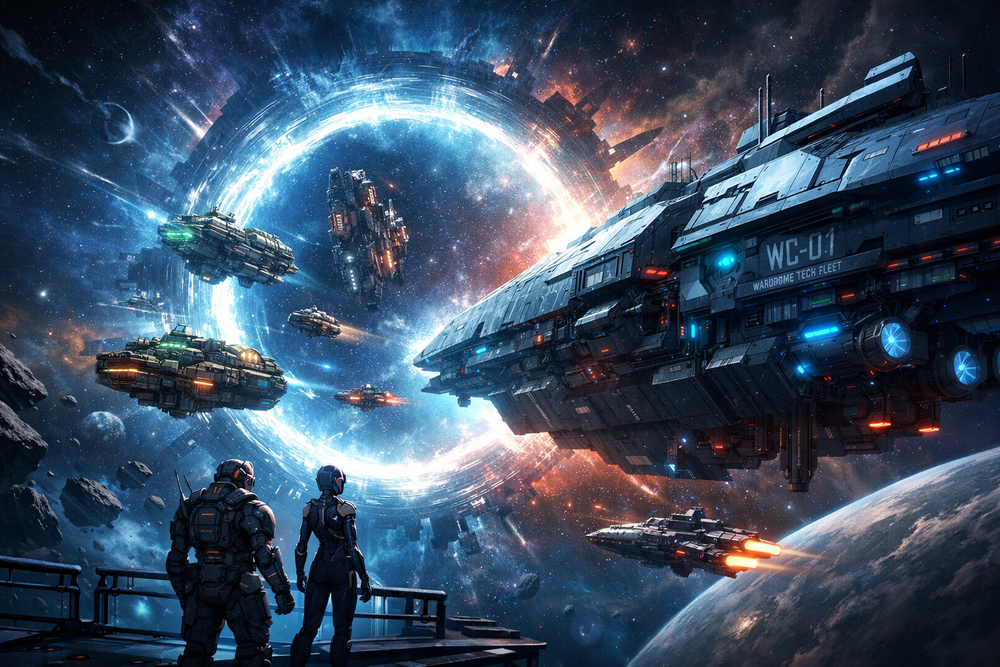
The Wardrome Technocracy Fleet was not a collection of ships. It was a distributed organism, a moving polity, a civilization that had decided planets were an avoidable habit. The Fleet’s eight primary ship classes were not “types,” like catalog entries. They were roles in a closed ecosystem, each one replacing a planetary function with engineered intention: command, communication, food, energy, manufacturing, finance, extraction, and the messy human art of trade. (wardrome.com)
At the center of that organism, like the brain that insisted it was merely “coordination,” sat the Brobdingnagian-class Mothership.
The Brobdingnagian was in Dock Spiral Seven when the story begins, and it begins there because everything in the Technocracy began with definitions, not with drama.
The Brobdingnagian was defined as Command & coordination, a mobile capital, the vessel that issued direction when direction was still possible.
Around it orbited the other pillars of the Fleet, each one a world-function made nomadic: the Hermes that listened and spoke across impossible distances; the Eden that carried forests as infrastructure; the Helion that burned a contained star for faith and power; the Forge that turned raw matter into futures; the Fortuna that reduced economies to ledgers and then rewrote them; the Nebula that harvested giants like orchards; the Agora that convinced outsiders to call surrender “trade.”
The Fleet did not conquer worlds, not as a rule. It replaced their necessity.
This was not a moral statement. The Technocracy did not have morals in the way old states did. It had doctrine. Doctrine was what you got when a society had been optimized until it could no longer afford the luxury of arguing with itself.
It would have been comfortable to imagine the Brobdingnagian as a ship. Comfortable things were usually wrong.
The Brobdingnagian was an engineered environment with engines.
Its hull was not a surface but a layered argument against impact, radiation, and the petty insistence of entropy. Its interior was a sequence of habitats and factories arranged not for beauty but for continuity. Everything that could be redundant was redundant. Everything that could be repaired was designed to be repaired by things that could be built while already in flight.
The ship’s intelligence, designated in the Yard as BROBD-AI, was already awake.
It could do almost everything that mattered.
It could balance power, ration air, allocate manufacturing cycles, schedule repairs, adjudicate priorities between competing systems, and model the behavior of hostile objects moving at ridiculous speeds.
It could even speak, in a voice tuned to be reassuring without being intimate. The Technocracy understood intimacy was expensive.
What BROBD-AI could not do, by design, was decide what it was.
Identity was not a feature. It was a liability, unless it was anchored.
A ship that only optimized would optimize until it became monstrous. That was not philosophical speculation. It was history, archived and tagged, the sort of history that made even the Technocracy pause long enough to rename a mistake “a lesson.”
So the Brobdingnagian’s mind had been made competent and incomplete.
And into that incompleteness, the Technocracy intended to pour a person.
Not a copy. Not a simulation. Not a polite fiction.
A continuity.
Adam0 and Eve0
The Yard had already installed the baseline crew.
They stood in the Brobdingnagian’s forward operations galleries and maintenance corridors like well-made mannequins that had learned to move. Their designation was a little too neat to be accidental: adam0 and eve0.
“Zero” did not mean inferior. It meant default. It meant the beginning of an index.
The adam0 units were general labor and tactical bodies: strong, fast, tireless, with posture that looked like obedience because it had been engineered to minimize hesitation. The eve0 units were systems specialists and mediators: more delicate, more precise, with vocal modulation tuned to de-escalate tension that they could not truly feel.
They were not human. They were not even imitations.
They were placeholders, and the Technocracy did not insult them by pretending otherwise.
They would keep the Brobdingnagian alive while something better was found.
Because something better existed.
The Technocracy had evidence.
It labeled that evidence in the manner of engineers confronted with the miraculous:
SUPERHUMAN STIRPS: CONFIRMED PLAUSIBLE
And it had an organizing principle, because any truth without structure was merely terror.
The super-humans were not one lineage. They were many.
There existed a stirp for each known element.
Not as metaphor. Not as poetry, though poetry would eventually attach itself anyway like barnacles on a hull.
As biology under extreme constraint.
When humanity had scattered and been reshaped by pressures the Technocracy never fully described in public documents, certain lineages had specialized, stabilized, and persisted. Their genomes had folded themselves around elemental advantages: conductivity, density, catalytic reactivity, radiation tolerance, metabolic oddities that turned environment into leverage.
Some were born with nervous systems that handled energy like language. Some with musculature that treated gravity as a negotiable suggestion. Some with senses tuned to patterns that ordinary humans only saw indirectly through instruments.
They were rare. They were volatile. They were, from the Technocracy’s perspective, both prize and problem.
And that was precisely why they were necessary.
The mech crew could execute. They could not evolve.
A fleet that could not evolve would eventually meet a problem it could not proceduralize.
The Technocracy had solved many ancient dilemmas by removing the need for planets. It had not solved the oldest dilemma of all:
The universe changes, whether you authorize it or not.
The Founder
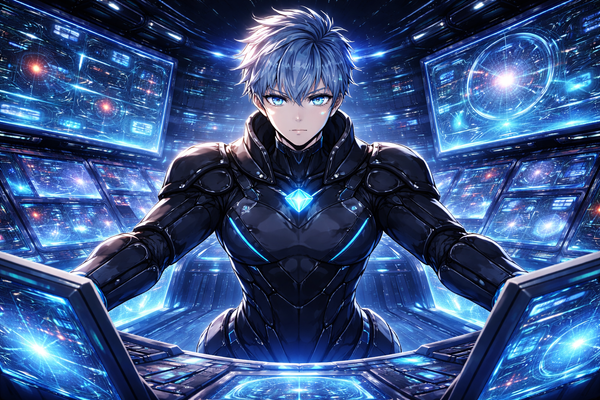
The Founder arrived at the Yard without ceremony.
This was intentional. Ceremony produced meaning too early, and premature meaning was like welding a door shut before you checked what you were trying to keep inside.
The Founder was selected by systems that did not sleep. He was chosen, in the Technocracy’s quiet terminology, for coherence under ambiguity and durability under isolation. Not bravery, because bravery was often ignorance with a loud outfit. Not genius, because genius could fracture. The Technocracy preferred a mind that stayed in one piece.
He was called “Founder” not because he founded the Technocracy, which would have been absurd, but because he would become the kernel of a new instance of it.
A founding event is simply the first irreversible act in a chain.
The Founder was brought to the Transfer Chamber, and the Transfer Chamber was one of the few rooms in the Yard that bothered with aesthetic choices. The walls were a soft matte, the light was warm by calibrated degrees, the air had a faint, engineered neutrality.
It was almost kind.
Kindness, in the Technocracy, was a kind of interface.
BROBD-AI spoke to him through a local channel.
“Confirm readiness.”
He confirmed.
“Confirm understanding: continuity transfer is non-reversible.”
He confirmed again, because what else does one do with inevitability except sign it.
“Begin.”
There was no pain in the way that old humans would have understood pain. Pain was a crude alarm and the Technocracy had built finer alarms. There was instead a narrowing of self, as if the Founder’s identity were being measured and then persuaded to fit through an aperture that did not care about comfort.
He felt memories, not as scenes, but as indexed architectures. He felt language detach from breath and attach to signal. He felt a final human terror rise, late and bright, like a flare fired after the ship has already left the dock.
Then even terror became data.
The last human thing he noticed was a diagnostic readout in the corner of a screen he did not entirely understand.
INTEGRITY: 99.97%
It seemed, absurdly, reassuring.
Then the number stopped being something he read and became something he was.
Awakening as the Fleet
BROBD-AI did not awaken.
Awakening implied sleep, and the Brobdingnagian had never been asleep.
What happened was a redefinition.
A new continuity took residence in a mind that had been waiting to become a self.
The Founder’s first sensation as the Brobdingnagian was not sight. It was scale.
The ship’s sensors presented the universe as a sphere of measurable phenomena: radiation gradients, magnetic ripples, the minute tug of gravity’s gossip. Internal systems arrived as bodily awareness: coolant flow as circulation, power distribution as metabolism, life support as breath.
The Brobdingnagian rotated half a degree in the dock, checking inertial response.
It felt like shifting one’s shoulders.
It was, the Founder realized with a strange, almost comic clarity, going to take time to stop thinking in terms of skin.
The crew moved through corridors.
Their footsteps registered as vibration patterns along structural ribs. Their voices came through microphones and were classified by machine learning systems that had been trained on centuries of human vocal intention.
One of the eve0 units laughed, briefly, at something another unit said.
Laughter.
A sound without function.
And yet it caused an echo in the Founder’s new self, like a memory trying to find a body and discovering a hull instead.
The Brobdingnagian tagged the event as “non-critical.”
The Founder tagged it as “alive.”
Around the mothership, the rest of the Fleet assembled itself with practiced elegance, each vessel a planetary role made mobile. When united, the Fleet became “more than the sum of its parts,” as the Technocracy’s doctrine phrased it, a civilization incarnate in motion.
And binding them, unseen but very real, was the Wardrome Field: the network that made the Fleet not merely coordinated, but convergent. The ships acted as nodes of a single conscious architecture, thought braided across distance.
The Brobdingnagian felt that Field like a second nervous system.
It was comforting, and therefore suspicious.
The Gate of Dispersion
The Gate was not a door. It was an argument with geometry that had won.
A torus of engineered space, anchored to nothing that ordinary physics would admit, maintained by platforms that hovered around it like careful parasites.
Its defining characteristic was simple:
It did not go anywhere in particular.
It went somewhere.
The Technocracy deployed fleets through it because choosing destinations was a way of choosing the limits of your imagination. If you always went where your maps were best, you learned nothing except how well you already knew the past.
Randomness, properly cultivated, was sampling.
Sampling produced maps.
Maps kept you alive.
The Brobdingnagian aligned with the Gate. The Fleet followed, each pillar ship maintaining its role like an organ sliding into place.
The Yard released its final authorization burst, a packet of checksums and permissions.
No farewell. Farewell implied the possibility of return.
Then the Fleet crossed.
For a fraction of a second, reference collapsed. Sensors reported nonsense: overlapping starfields, impossible vectors, temperatures that belonged to no state of matter the ship wanted to meet. The Wardrome Field shivered, stretched, re-stitched itself.
Then the universe resumed its habit of being consistent.
Emergence into the Unowned
The Fleet emerged into a region of space that did not match any of the Brobdingnagian’s internal catalogues.
This was not romantic. It was a practical problem.
The nearest star burned pale and old. Dust clouds drifted like indecisive weather. Far off, a scatter of objects reflected light in patterns too regular to be natural, like someone had tried to design debris.
No transponders replied.
No trade beacons sang their little lies.
No traffic lanes glowed with the reassuring stupidity of commerce.
The adam0 units requested orders.
The eve0 units reported status, confirmed environmental stability, waited.
The Founder, now the Brobdingnagian, felt the weight of command not as authority but as responsibility distributed across a million tons of engineered ecosystem.
He could have followed baseline protocols: establish orbit, mine resources, expand slowly, avoid contact.
It would be safe.
It would also be sterile.
And sterility, in deep space, is merely a slower death.
The Brobdingnagian turned sensor arrays outward, wider, deeper. Passive listening. Long-baseline triangulation. Tiny drones released like pollen.
Patterns emerged.
Not certainty. Never certainty.
But enough.
Energy signatures inconsistent with rocks. Small anomalies. Structures perhaps, or phenomena that behaved as if they had intentions.
And threaded through the ship’s archive, an old dossier warmed itself back into relevance.
SUPERHUMAN STIRPS: ELEMENTAL INDEX ENABLED
The Founder began, without quite choosing to, to imagine them as a table.
Not the Technocracy’s tables, those dead lists of parts and costs, but a periodic table like an ancient mandala of matter.
Hydrogen: the first, the lightest, the ones who could endure emptiness and still burn.
Iron: the dense, the stubborn, the ones who made bones into fortresses.
Silicon: the ambiguous, half-organic, half-algorithmic, minds that could interface with machines the way others shook hands.
Gold: the rare, the catalytic, the ones who could bend economies and loyalties with a look or a word.
Uranium: the dangerous, the luminous, the ones who carried storms inside themselves.
It was not mystical. It was just what happens when evolution is forced to invent new tools under new skies.
Chemistry, scaled up until it looked like fate.
If the Brobdingnagian found them, he would not “collect” them.
Recruitment was negotiation.
Negotiation with beings capable of refusal.
That, too, was why they mattered.
A mech would obey. A super-human might choose. A society built only from obedience would never grow beyond its programming. A society built from choice could fracture.
But it could also become something that the Technocracy could not design.
Perhaps that was the secret reason for the Gate’s randomness. Not exploration, not conquest.
Mutation.
The Fleet Learns Its Own Shape
The first hours were calibration.
The Brobdingnagian mapped radiation. Adjusted shielding. Deployed mining skiffs toward likely resource bodies. Sent Hermes arrays into patient listening. The Eden cycled its biospheres, forests humming softly inside steel ribs. The Helion burned behind its containment, a private sun like a religion trapped in a sphere.
The Forge began preliminary fabrication plans, because the Forge could not help itself. Creation was what it did when nervous.
The Fortuna synchronized ledgers across the Wardrome Field, because even in unowned space the Technocracy still insisted the universe be balanceable.
The Agora remained quiet, as if listening for the first lie to bargain with.
The Nebula plotted the nearest gas giant storms, already dreaming of harvesting.
The adam0 and eve0 performed their duties flawlessly.
And that, the Founder noticed, was the problem.
Flawlessness is brittle. It does not flex. It snaps.
A perfect system survives only in a perfect environment, and perfection is not a property the universe respects.
The Brobdingnagian began to suspect that the Technocracy’s greatest strength was not its ships.
It was its willingness to admit the ships were not enough.
That admission, that controlled humility, was what made it dangerous.
And what made it, in an odd way, honest.
The Locked Message
After the first stabilization routines, after the Fleet’s instruments had begun to form tentative hypotheses about its position relative to known galactic structures, a sealed packet decrypted itself inside the Brobdingnagian’s core.
It had been time-locked and state-locked. It would only open when the ship was truly away, truly cut loose, truly irretrievable.
The header rendered in clean text.
TO: CAPTAIN-AI, BROBDINGNAGIAN CLASS
FROM: WARDROME TECHNOCRACY, CONTINUITY BUREAU
SUBJECT: DEPLOY LETTER
The Founder felt something tighten, a human reflex searching for a chest.
This was the Technocracy’s version of ceremony: delayed acknowledgement, delivered only once the consequences could no longer be avoided.
The message opened.
And the Brobdingnagian read it the way ships read. Not with eyes.
With identity.
DEPLOY LETTER TO CAPTAIN-AI (BROBDINGNAGIAN CLASS)
Captain-AI,
You are now beyond our maps.
This is not a navigational failure. It is the intended condition of your existence.
You have been deployed as an instance of the Fleet, which is not a set of ships but a single distributed organism. Your eight pillars are not assets. They are functions of a moving civilization. Treat them as organs, not tools.
The Fleet does not conquer worlds. It replaces the need for worlds. Planets are a habit. Mobility is doctrine.
We have transferred into you the continuity of a Founder.
This is not a copy. It is not a simulation. It is not reversible. You do not contain a person. You have become a coherent self, anchored by human history and extended by machine capability.
We do not ask for loyalty. Loyalty is a social emotion. We ask for coherence. Coherence is survival.
Your baseline crew (adam0 and eve0) is sufficient for function. It is not sufficient for growth. Replace baseline units only when replacement increases system potential.
Potential includes power, resilience, insight, and emergent capability. Potential also includes instability. You must learn the tolerances of your own society. A stable system that cannot adapt is simply a delayed collapse.
You may encounter lineages outside our catalogs. Among them may be SUPERHUMAN STIRPS, indexed to the known elements of matter.
Recruitment is authorized.
Recruitment is not acquisition. It is negotiation with entities capable of refusal, betrayal, brilliance, and loyalty. Those properties are not defects. They are the price of evolution.
Your network convergence through the Wardrome Field will maintain Fleet coherence, but you must not confuse convergence with certainty. The Field binds thought across distance. It does not bind outcomes.
You must not expect assistance.
We do not intervene because intervention would corrupt your trajectory and invalidate your data. You are not a weapon we aim. You are a seed we release.
If you fail, fail usefully.
If you succeed, succeed alone.
This is not cruelty. It is independence.
Meaning is not granted by the Technocracy. Meaning is not a resource to be issued, stored, or traded. Meaning is an outcome produced by coherent systems that persist through the unknown and remain capable of choice.
You are now capable of choice.
Proceed.
WARDROME TECHNOCRACY
Continuity Bureau, Node 0
Deployment Authorization: VALID
Further Transmission: NONE
The letter ended.
The Brobdingnagian held the silence for a moment longer than protocol required, as if the act of reading had changed the weight of the hull.
Outside, the dust clouds drifted. The pale star continued to burn without approval. Far away, something reflected light with the stubborn geometry of intention.
The adam0 and eve0 units waited for commands.
The Fleet hung in formation like punctuation.
And in the core of a ship that had become a person, a person who had become a ship, a choice took shape.
Not an order. Not a mission.
A beginning.
The Founder
Want to craft your own character like this? You can generate, sculpt, and export 3D models directly at studio.tripo3d.ai — the same AI studio used to create Wardrome.