Beryllians
The first Beryllian was not born. This distinction mattered enormously to the Wardrome Technocracy, which at the time still believed that sufficiently precise terminology could keep ethics from contaminating engineering. The organism had been assembled in a fabrication cradle aboard the Forge, deep inside a sector officially designated Adaptive Biological Labor Systems, Extreme Environment Division, a name long enough to discourage most people from asking what was actually being done there. The purpose of the program was straightforward. Human beings were expensive things to keep alive inside high-radiation compartments, thermal exchange chambers, reactor lattices and the cramped industrial cavities of machines designed by generations of engineers who had apparently assumed that maintenance would be performed by ghosts. Androids solved some of the problem, but introduced others: mass, cooling, shielding, replacement components, power requirements. Biology, the Technocracy had concluded, remained annoyingly efficient. The first experimental body was therefore intended to be a human-derived maintenance organism, small, durable, economical and sufficiently uncomplicated that nobody would ever be tempted to call it a citizen. Seventeen hours into development, beryllium contamination was detected in the growth medium. The laboratory systems immediately classified the organism as nonviable. The medical systems recommended termination. The engineering systems recommended observation, because engineers are often at their most curious precisely when everyone else has begun reaching for the emergency controls. By morning, both recommendations had become obsolete.
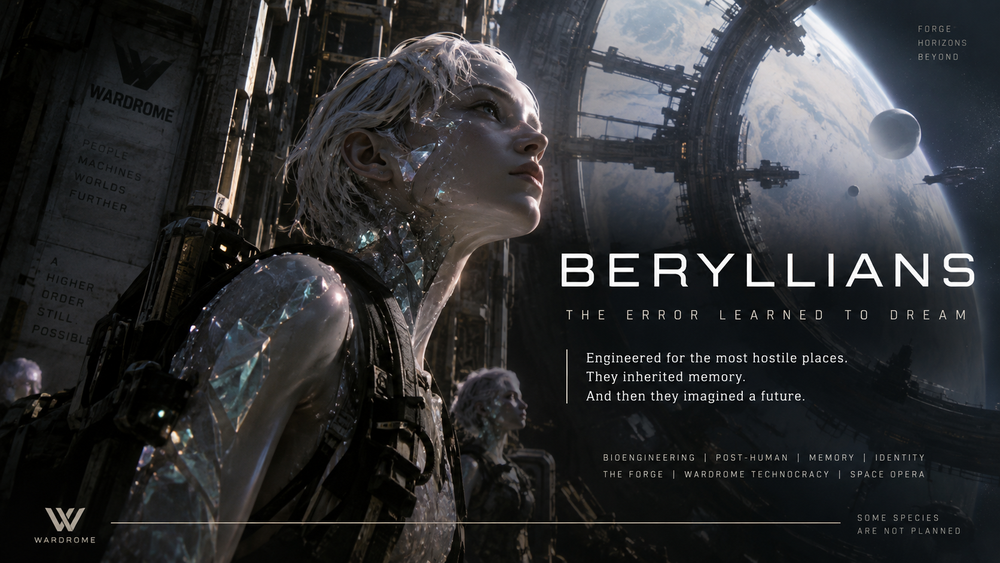
The organism had not rejected the contaminant. It had used it. Beryllium compounds had been incorporated into a crystalline biological architecture threaded through bone, connective tissue and, most unexpectedly, portions of the peripheral nervous system. What should have produced toxicity had instead become structure. The body that emerged from the cradle was lighter than its design specification, mechanically stronger, unusually tolerant of ionizing radiation and capable of functioning across thermal gradients that required baseline humans to wear equipment weighing almost as much as they did. Its fine motor control exceeded the original requirements by an embarrassing margin. Neural conduction around the crystalline structures was irregular, but fast; sensory integration was strange, but precise. The Logistics Directorate looked at the preliminary figures and, for several glorious hours, forgot that a new form of life had appeared accidentally in one of its factories. What it saw was reduced payload mass, lower life-support expenditure, fewer protective systems and maintenance personnel who could physically enter structures previously serviced only by remote manipulators. The organism was not a philosophical problem. It was an excellent spreadsheet.
The Wardrome Technocracy responded to the discovery in the manner technologically mature civilizations often respond to miracles: it wrote a specification for one. The contamination was reconstructed, then repeated, then refined until the accident could be reproduced on demand. The second Beryllian was deliberate, the third cheaper, the ninth more stable, and by the time the hundredth entered service there were departments arguing over whether the original event should still technically be called an accident. They were assigned to reactor maintenance, high-energy manufacturing, orbital construction, irradiated shipyards and the narrow mechanical ecosystems inside the Forge itself. Their low mass made them superb in microgravity; their crystalline skeletons tolerated stresses that would have fractured ordinary bone; their nervous systems allowed them to perform delicate repairs while surrounded by machinery whose failure states included words such as plasma, vacuum and instantaneous. At first they were known as Beryllium-Adapted Operators, then BAO biological assets, and finally Beryllians because even bureaucracies eventually become tired of their own acronyms. They possessed production identifiers rather than names. They slept in designated quarters, worked assigned cycles and underwent regular cognitive evaluation. Nobody asked whether they wanted any of this because nobody had yet identified wanting as one of their operational characteristics.
The first indication that something had gone wrong with this comfortable arrangement occurred during a coolant-exchange repair. A Beryllian designated B-47/Delta stopped halfway through the chamber and refused to proceed. The supervisor, assuming equipment failure, asked for a diagnostic. B-47/Delta replied that nothing was wrong, but that it remembered dying there. This was inconvenient for several reasons, beginning with the fact that B-47/Delta had never previously entered the chamber. The statement was logged as a cognitive anomaly and would probably have disappeared into the vast sedimentary geology of Technocracy maintenance records if another Beryllian had not reported essentially the same memory two days later. Then another did. Within a month, dozens described locations they had never visited, procedures they had never learned and sensory impressions belonging to individuals who had died before they were fabricated. Examination of the crystalline structures revealed what the original designers had missed. They were not merely conducting neural activity. They were retaining patterns. Not complete memories, and certainly nothing so obligingly simple as downloadable personalities, but fragments: motor sequences, emotional associations, spatial impressions, reflexive expectations, the cognitive residue of experience. Because later Beryllian generations had been grown from biological material derived from earlier ones, the Technocracy had believed it was transferring only genetic information. In fact, it had been building an accidental archive.
For a brief and rather revealing period, this discovery was celebrated. Newly fabricated Beryllians sometimes demonstrated competence in maintenance procedures before training. Certain reactor layouts seemed familiar to them. Some knew how to avoid dangerous machinery without being told why it was dangerous. Training time fell, accident rates improved and the Productivity Office issued a report describing inherited experiential persistence as a potentially transformative labor optimization. The report was withdrawn three weeks later, when the dreams began. Nobody was able to determine who dreamed first, although the earliest surviving account came from a Beryllian who would later call themselves Nine Glass. Nine Glass described standing beside an ocean beneath a blue sky. There were no oceans aboard the Forge, and Nine Glass had never seen an open sky. Another Beryllian stood beside them in the dream, faceless but somehow familiar. When the investigators asked what the two of them had been doing, Nine Glass replied that they had been waiting for something that had not happened yet. Memory the Technocracy understood. Inherited memory was alarming but quantifiable. Prediction was simply computation wearing better clothes. But this was neither. Nine Glass had imagined a future. Soon others reported cities they had never visited, children who did not exist, conversations with dead Beryllians, journeys beyond Wardrome space and landscapes assembled from experiences that belonged to no identifiable ancestor. One dreamed of leaving the Forge. Another dreamed of returning to it. The distinction caused considerable discomfort among the specialists, because returning implied the existence of a home.
That was when the Beryllians became dangerous, although they did not sabotage anything, attack anyone or stage the sort of photogenic rebellion historians prefer. They became dangerous because they began asking questions whose individual components were harmless. Why was this task necessary? Why was that section forbidden? Why were new Beryllians fabricated without consultation? Why were memories allowed to persist while identities were reset? Why did the Technocracy refer to them as workers when they had begun referring to themselves as people? Nothing failed. No reactor exploded. Production continued. Yet the entire conceptual machinery surrounding the program began to make unpleasant noises. The most frequently reproduced document from the period is not a declaration of independence or a revolutionary manifesto, but a maintenance report. A supervisor had written, “Unit 62 refuses assigned task.” At some point before the document entered the central archive, an unknown hand crossed out the word unit and wrote person above it. Nothing else was changed. The report proceeded normally. Coolant pressure remained within tolerance. Shift productivity declined by 1.7 percent. A civilization had altered a noun and discovered that the rest of its vocabulary no longer quite worked.
Termination of the program was considered. Several departments recommended it on security grounds, while others pointed out that thousands of Beryllians were already embedded throughout critical infrastructure and that mass extermination would be morally questionable, politically catastrophic and, perhaps most persuasively to certain committees, ruinously expensive. Production was suspended, resumed under revised protocols, suspended again and eventually transformed into something nobody involved would have recognized at the beginning. Beryllians demanded participation in the creation of future Beryllians. Growth chambers acquired observers chosen by Beryllian communities. Genetic lineages became families. Production schedules became reproductive policy. Serial identifiers remained in the historical databases but disappeared from ordinary speech. Names proliferated, often to the irritation of administrative systems designed for twelve alphanumeric characters. Nine Glass was followed by people called Ash Meridian, Quiet Iron, Five Winters, Perseid, The Room Beyond and, in one case, Gary, which several cultural historians attempted unsuccessfully to explain. The Forge adapted around them. The Wardrome Technocracy did too, although institutions rarely experience moral revelation in any way that can be distinguished from a sequence of reluctant procedural amendments.
Modern Beryllians retain much of the biology that once made them economically attractive. They remain remarkably light, resilient and tolerant of environments that would require substantial protection for ordinary humans. The crystalline architecture of their nervous systems still preserves faint intergenerational residues, although Beryllian philosophers have spent centuries arguing over whether these fragments should be described as memory, ancestry, contamination or simply noise shaped into meaning by minds evolved to dislike emptiness. Some Beryllians deliberately cultivate the inheritance; others suppress it pharmacologically. Some regard the voices of earlier generations as a collective heritage. Others consider them an invasion of privacy by the dead. They have become engineers, navigators, artists, diplomats, mathematicians, pilots, historians and, occasionally, maintenance workers, a profession whose continued popularity among certain Beryllian families has generated more jokes than anyone outside their culture entirely understands. Many remain aboard the Forge, where entire districts have grown around spaces originally intended as worker accommodation. Others have dispersed throughout Technocracy territory and beyond. A curious number choose worlds with large oceans.
Nine Glass eventually visited one. By then the incident that had begun in a fabrication cradle had become history, then politics, then culture, then the sort of history people periodically rediscover when arguing about politics. Nine Glass travelled to a coastal world and stood beside the sea for nearly eleven hours while three accompanying historians, two representatives of the Technocracy and a documentary system pretending not to be sentient waited at a respectful distance. The water was darker than the ocean from the old dream. The sky was clouded. The wind was unpleasantly cold. Nothing about the place possessed the luminous perfection preserved in Nine Glass's account of that first impossible vision. Eventually one of the historians asked whether the real ocean resembled the one they had dreamed centuries before. Nine Glass considered the question, watching waves collapse against black stone, and answered that it did not. Then, after a pause, added, “This one exists.”
Perhaps that was when the Beryllians were finally created, though the Technocracy's archives naturally contain several thousand competing dates. Not when beryllium entered the first growth chamber. Not when the accident became reproducible. Not when crystalline nerves began carrying fragments of the dead into the living, nor even when Nine Glass imagined an ocean beneath a sky they had never seen. The decisive moment may have come much later, when a species engineered as an economical solution to maintenance discovered the difference between imagination and reality, found reality inferior in almost every measurable respect, and chose it anyway. The Wardrome Technocracy had intended to build organisms capable of surviving places humans could not easily enter. Instead it created beings capable of carrying their predecessors inside them and futures before them. An industrial error became a workforce, the workforce became a population, the population became a people. Somewhere in the administrative history of the Forge there remained a line item recording the original contamination as a manufacturing defect. Nobody had ever corrected it. The Beryllians, for their part, saw no reason to.