AI Music Is “No Work”?Then You Mix My 12 Stems at 3 A.M.
If you believe AI music is “effortless,” I have great news: you’re hired. Your first task is to sit beside me at 3 a.m. and lovingly spoon‑feed a mix session until it stops sounding like a wet cardboard drum kit arguing with a synth. No pay, obviously—because according to the internet, none of this counts as work.
Here’s the part that melts the “one click” fairy tale: AI doesn’t delete the music pipeline. It relocates the labor. Generation gets faster; judgment, editing, and engineering still happen at human speed.
And this isn’t just my melodrama.
François Pachet,ai music researcher describes AI-assisted music creation like this:
“You give an idea, and the system fills in the blanks, but then you criticize the results.”
Exactly. The output is cheap. The curation is the job.
Even people deep in AI music experimentation say the “effortless” framing is nonsense. Taryn Southern, musician technologist put it bluntly when describing her own AI-driven workflow:
“Southern takes the music that AI creates and spends countless hours tweaking it.”
So yes: welcome to the land of infinite drafts.
The Wardrome OST pipeline (a.k.a. “where the work hides”)
Lyrics (human, stubborn, real).
I write and rewrite. I cut lines that look clever but sing badly. I rebuild verses that don’t breathe. This is not “prompting.” This is songwriting. And it’s the foundation I refuse to outsource—because if the words don’t mean something, the track is just wallpaper.
Prompt design (translation, not magic).
Then I translate the idea into instructions. Suno itself tells you to be specific—genre, mood, instrumentation—and to use structure tags like [Verse] and [Chorus], because clarity improves results.
So the prompt becomes a creative brief: not “make it cool,” but “make it this kind of cool.”
Trials in Suno (auditions, not miracles).
Here’s the part people misunderstand: generating audio isn’t the finish line, it’s the starting gun. Suno’s own guide notes it can give you multiple versions to compare, and the workflow is explicitly “listen and refine.”
That means… I generate. I listen. I reject. I adjust. I generate again.
Over and over. Like casting actors—except the actors are choruses.
Suno Studio (the “AI did it” crowd never shows up here).
When I finally find a seed worth keeping, I move into Studio. Suno describes Studio as a web-based Generative Audio Workstation with multitrack layering, arranging, editing, tempo control, and stem extraction.
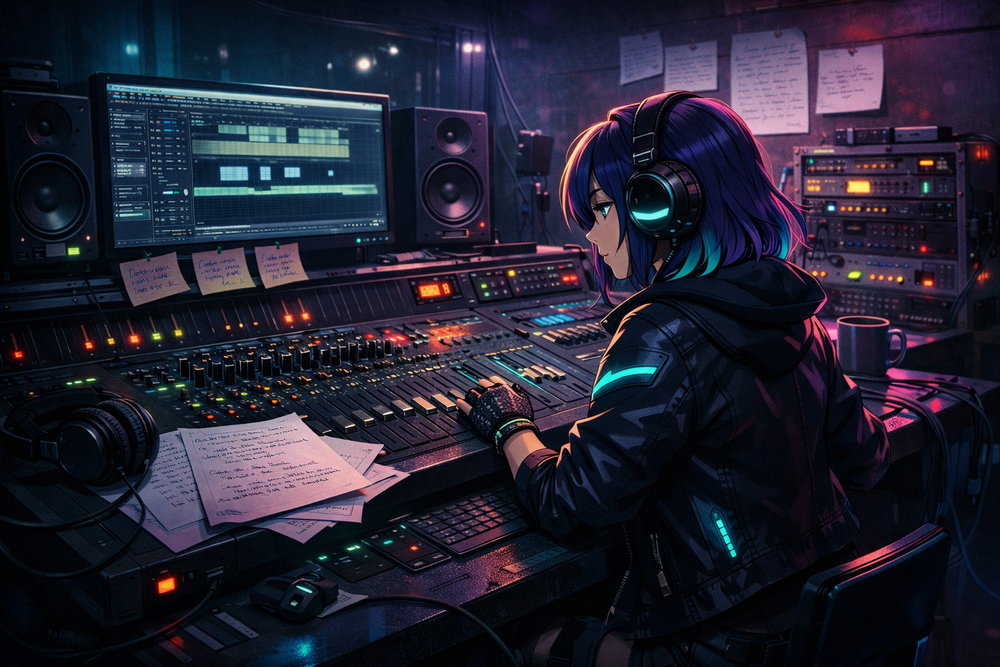
I’m now making DAW decisions. Structure. Dynamics. When the chorus hits. What gets muted. What stays. What dies.
And here’s the funniest part: the more control you gain, the more work you inherit.
Exporting stems (multiplying the problem on purpose).
Then I extract stems. Suno’s stem feature can break a song into parts (including a multi-stem option), which is amazing because it gives you real mixing control.
It’s also amazing because you’ve just turned “one song” into “many files” and invited engineering into your life.
Studio even supports exporting individual clips as high-quality WAV.
Again: not effortless. Just more editable.
Mixing in Audacity (where the fantasy finally gets bullied).
Now we arrive at the supposedly “minor” step that causes most AI tracks to die in the wild: mixing.
Audacity’s manual explains that once you mix down, unmixing is basically impossible—like trying to remove banana from a banana milkshake.
So you don’t treat this like a casual export. You treat it like commitment.
And Audacity isn’t a magic auto-master tool. The community documentation explicitly notes mixing is summation (hello clipping), and that Audacity doesn’t have a master-mix level control—so you manage levels carefully (or export floating point and normalize later).
This is engineering. It’s ears. It’s checking translation. It’s “why does the vocal vanish in the chorus,” and “why does the low end explode on speakers.”
A pro mixer’s attitude applies here too. Andrew Scheps, mix engineer, once summed up the pain of releasing too early:
“It’s a hollow feeling if you let a record go too early.”
Yes. That feeling. That’s the mix screaming, “come back.”
Mastering (the last creative gate and the first technical gate).
Mastering isn’t just volume. It’s final taste and final quality control.
In a PBS interview, mastering legend Bob Ludwig explained it as two hats:
“The mastering engineer wears two hats. The first one is the creative hat.”
That’s the truth: mastering is a last artistic decision and a technical preparation step.
Distribution via TuneCore (a pipeline, with gates).
Then comes the administrative reality check: distribution. TuneCore describes a content review process before delivery and notes that stores have their own processing timelines—meaning you can’t just “upload and instantly exist everywhere.”
TuneCore even markets a tracker page with a line that accidentally tells the truth:
“You pour your blood, sweat, and tears into writing and recording a song.”
Exactly. Even the distributor knows it’s labor.
So what does AI do here—actually?
It accelerates the moment where you go from “idea” to “auditionable audio.” That’s real. And it’s useful.
But, as AI researchers keep reminding us, the system doesn’t magically know what is good. Pachet put it in the plainest way possible:
“The tool does not have any idea about what it creates.”
So if you want something coherent, emotional, intentional—congratulations. You are now the quality filter. You are the director. You’re the one making the calls.
And if anyone still insists AI music equals zero artistry, I’ll happily offer them the full experience: they can click “Generate,” and then they can carry the mix for the next six hours.
I’ll be over here doing the “no work” part: listening, choosing, rejecting, editing, exporting, mixing, mastering, and shipping.
This article is dedicated to my foster son, Yankï Suner,
who dismisses every AI-assisted creation with the same sentence:
“Yeah, but it’s made with AI.”
This one is for you.